

Most law firm websites look the part. Professional headshots. A polished color scheme. Partner bios with impressive credentials.
And yet they fail to generate cases.
The problem is almost never how the site looks. It's what the site is missing: specific, functional elements that move a visitor from curious to committed.
A law firm website also has ethics boundaries. ABA Model Rule 7.1 addresses communications about a lawyer's services, while Google's Web Vitals explain the performance side of user experience.
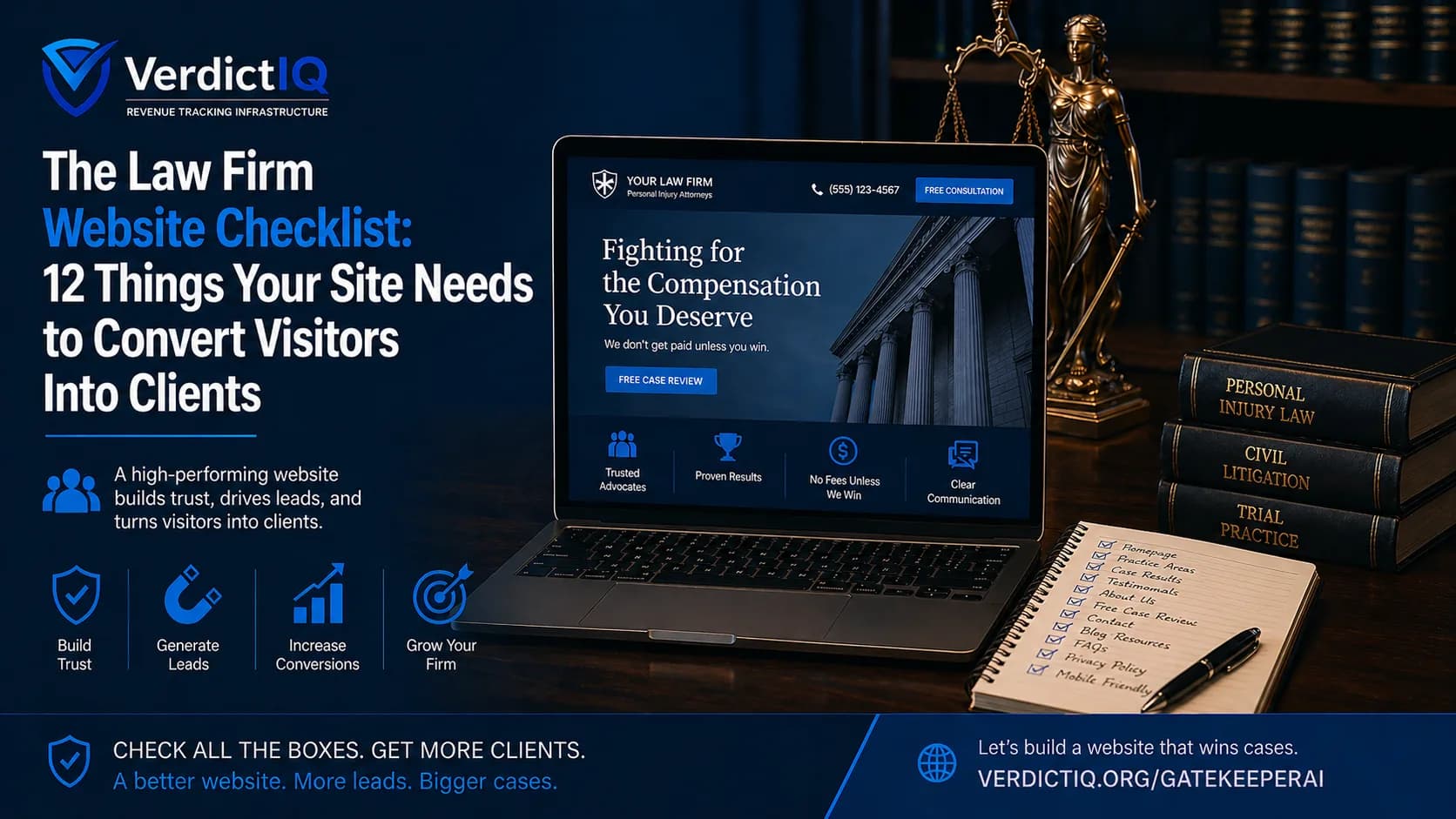
Here are the 12 things every law firm website needs to actually convert traffic into signed clients.
1. A Headline That Speaks to the Outcome, Not the Firm
Your homepage headline is the first thing a prospective client reads. If it leads with your firm name or your years of experience, you have already lost most of them.
People searching for a lawyer are scared, overwhelmed, or angry. They want to know: can you solve my problem?
- Weak: "Smith & Associates: Serving Orange County Since 1989"
- Strong: "We Help Orange County Families Win What They're Owed After an Accident"
The second one converts because it speaks to the visitor's situation, not the firm's resume. Every word on your homepage should pass this test: does this help a prospective client decide to contact us, or does it just make us feel good?
2. A Single, Clear Call to Action Above the Fold
The fold is the area visible on screen before a visitor scrolls. It has one job: tell the visitor what to do next. One primary CTA, not three, not five.
- Book a Free Consultation
- Call Now for a Free Case Review
- Get Your Free Case Evaluation Today
Every additional button you add above the fold splits attention and reduces the likelihood that anyone clicks any of them. Pick the one action that matters most and make it impossible to miss.
3. A Click-to-Call Phone Number at the Top of Every Page
This sounds obvious. Most law firm sites still get it wrong.
The number needs to be in the header, visible without scrolling, and linked as a tel: URL so mobile visitors can tap and call in one step. More than 60% of legal searches happen on mobile. A phone number that requires effort is a phone number that does not get dialed.
A phone number buried in the footer is not a contact option. It is a decoration.
4. Trust Signals That Are Specific, Not Generic
"Experienced. Dedicated. Results-driven." Every law firm says this. It means nothing to someone evaluating whether to trust you with their case.
Specific trust signals convert. Generic ones get ignored.
- Bar association memberships with logos
- Case results with actual dollar amounts and case type
- Client reviews with full names and star ratings pulled from Google
- Verdicts and settlements listed by practice area
- Attorney photos that are real, not stock photography
A prospective client comparing three firms will not remember the one that said they were "dedicated." They will remember the firm that showed a $1.4M verdict in a case that mirrors their own.
5. Page Load Time Under 2.5 Seconds on Mobile
Site speed is not a technical detail. It is a conversion lever. Google's data shows that each additional second of load time reduces conversions by up to 20%.
For a law firm where a single signed case can be worth $20,000 to $500,000 in contingency fees, a slow site is not a minor inconvenience. It is a revenue problem.
Core Web Vitals targets to hit:
- Largest Contentful Paint (LCP): under 2.5 seconds
- Cumulative Layout Shift (CLS): under 0.1
- Interaction to Next Paint (INP): under 200ms
If your site fails these benchmarks on mobile, you are handing cases to faster competitors before a prospect ever reads your headline.
6. Practice Area Pages That Target Real Search Queries
Your homepage cannot rank for every practice area. Each major area needs its own dedicated page, built around the specific keywords your prospective clients actually search.
- "car accident lawyer [city]"
- "personal injury attorney near me"
- "workers comp attorney [state]"
- "slip and fall lawyer [city]"
Each practice area page needs a unique title tag, a unique meta description, its own H1, and at least 500 words of original content tied to that specific case type.
A homepage with a bulleted list of practice areas will not outrank a competitor with 10 dedicated pages optimized for each one. This is the single biggest SEO gap on most law firm websites.
7. Location and Service Area Pages for Every Market You Serve
If you serve multiple cities or counties, you need individual pages for each, not one page that lists them all in a sentence.
Local search works on proximity and relevance signals. A page titled "Personal Injury Attorney Orlando" with content tied to local courts, county statutes, and local case context will outrank a generic page every time.
Duplicate location pages with just the city name swapped out will be filtered by Google as thin content. Pages with genuine local relevance will rank and send targeted traffic.
8. A Contact Form That Actually Delivers Leads
Test your contact form right now. Submit it. Check whether the lead arrives in your inbox, your CRM, or anywhere at all.
Law firm contact forms fail silently more often than you would think, especially after website updates, CMS migrations, or email provider changes. The form appears to submit. The lead disappears.
A working intake form should:
- Deliver the lead to a monitored inbox within seconds
- Send a confirmation email to the prospect so they know it was received
- Fire a verified conversion event in GA4
- Log the submission in your CRM or case management system
9. Verified Conversion Tracking
If you are running Google Ads or paying for SEO, you need to know which campaigns are producing cases, not just traffic. That requires verified event tracking: form submissions, phone call clicks, live chat starts, and consultation bookings all mapped in GA4 with accurate attribution.
Without this, your marketing spend is a guess. You will scale campaigns that are not profitable and cut ones that are working.
This is one of the most common failure points we see on law firm sites. The forms submit. The GA4 events don't fire. No one notices for months. By the time someone checks, tens of thousands in ad spend have been allocated based on bad data.
For a complete breakdown of what GA4 needs to actually measure law firm leads, see our GA4 setup guide for law firms.
10. After-Hours Intake Coverage
A significant portion of legal inquiry calls come in outside of business hours. If your office is closed, you are losing cases to firms that are not.
The solution is not hiring a receptionist to work nights. It is building an intake system that handles qualification automatically, collecting case facts, screening for merit, and booking consultations without requiring a human in the loop.
AI intake systems built for law firms now do this reliably. A prospect calls after hours, has a real conversation with an AI, and wakes up to a booked consultation in the morning. The attorney reviews a case summary before the appointment. No leads lost to voicemail.
For personal injury firms in particular, after-hours intake is not a nice-to-have. It is a competitive necessity. If you want to see how this works in practice, read how PI firms are using AI to handle intake calls automatically.
11. Attorney Bio Pages That Build Confidence
Clients hire attorneys, not firms. The attorney bio page is often the page that converts, or doesn't.
A bio page that converts includes a professional photo, specific case results tied to that attorney, bar admissions, educational background, and a human-readable explanation of how they approach cases. It answers the question a prospective client is actually asking: is this person capable of handling my situation, and can I trust them?
A bio page that says "John Smith is an experienced attorney who is passionate about justice" converts almost nobody.
12. A Blog That Answers Real Questions Clients Search Before Hiring
People who are about to hire a lawyer Google their situation first. They search "what do I do after a car accident" or "can I sue if I was partially at fault" before they ever search for an attorney.
A blog that answers those questions captures informational search traffic and builds trust before the first phone call. It also creates internal linking opportunities that strengthen your practice area pages in search.
The key is answering real questions with genuine, specific answers, not publishing promotional content about your firm. The firms that rank on informational queries build an audience that eventually becomes clients. Promotional blog posts rank for nothing.
The Common Thread
Every item on this list serves the same goal: remove friction between a potential client finding your site and becoming a signed case.
A slow site loses them before the headline loads. A buried phone number loses them when they want to call. A broken contact form loses them when they try to reach out. A closed office at 9pm loses them to a competitor who had intake coverage.
This is not about having a nice-looking website. It is about having one that works, one where every element is engineered to move a visitor closer to becoming a client, not just to fill space on the page.
If your law firm site is missing any of these elements, the cases are going somewhere. They are going to the firm whose site has them.
VerdictIQ builds law firm websites with all 12 of these elements built in from the start. If you want to know what your current site is missing, book a free 15-minute site review.
For personal injury firms specifically, the website should also support a complete SEO and intake system. If rankings are the goal, the next step is personal injury lawyer SEO that connects visibility to signed cases.