

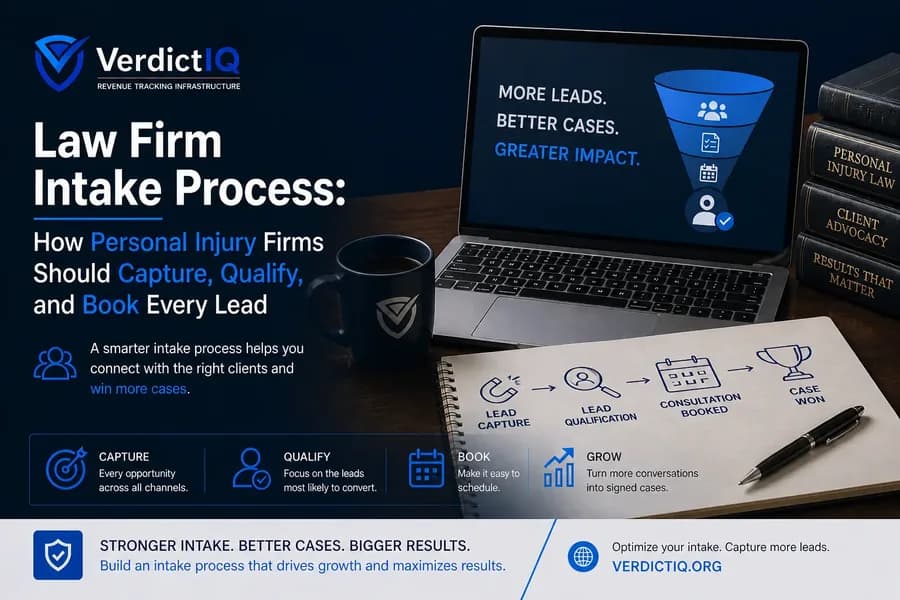
Most law firms lose cases before an attorney ever hears about them.
Not because of bad marketing. Not because of the wrong practice area. Because intake broke down somewhere between the first call and the signed retainer.
A structured intake process does not just improve efficiency. It directly determines how many qualified leads become paying clients, and how many disappear to a competitor who answered faster, asked the right questions, or followed up when your firm did not.
Because intake can involve sensitive facts before an attorney ever reviews the lead, confidentiality has to be designed into the workflow. ABA Model Rule 1.6 is the right primary reference point for client-information boundaries.
Here are the seven steps that separate firms that capture most of their inbound leads from firms that work hard on marketing and still feel like they are losing cases somewhere.
Step 1: Answer Every Call. Speed-to-Answer Is a Competitive Advantage
The most important moment in your intake process happens before any question is asked: whether the call gets answered at all.
Research on legal lead behavior consistently shows that prospects who do not reach a human on their first call will move to the next firm within minutes. They are not shopping for the best attorney. They are looking for the first one who picks up.
This creates three distinct leakage points firms rarely measure:
- After-hours calls that go to voicemail, and the 70% of legal callers who hang up without leaving a message
- Overflow calls during busy hours when staff cannot answer in time
- Calls that reach a receptionist who is not trained on intake and cannot qualify or book
Fixing speed-to-answer means having coverage at every hour, not just business hours. For firms that cannot staff this with people, AI intake systems now handle the full intake conversation automatically, answering immediately, qualifying the lead, and booking the consultation before the caller hangs up.
For a detailed breakdown of what missed calls are actually costing your firm in contingency fees, see the missed call cost calculator for law firms.
Step 2: Ask the Right Qualification Questions in the Right Order
Intake is not a casual conversation. It is a structured qualification flow with a specific goal: determine as quickly as possible whether this caller has a case your firm can and should take.
The questions vary by practice area, but effective intake always follows this sequence:
- Incident facts first: what happened, when, and where. This establishes the basis for everything that follows.
- Injury or damages: what the caller experienced and what they are still dealing with. This determines case value.
- Fault and liability: who was responsible and what evidence exists. This determines viability.
- Insurance and representation: whether coverage exists and whether the caller is already represented. These are disqualifiers if handled wrong.
- Statute of limitations: how much time has passed since the incident. This is a hard filter that should be identified early.
Intake coordinators who improvise this order frequently miss critical information, circle back to questions already asked, or spend 20 minutes on a call that should have ended in five. The questions are not negotiable. The order determines efficiency.
Step 3: Run a Conflict Check Before Going Further
No intake process is complete without a conflict check, and the earlier it happens, the less time is wasted on both sides.
Conflict checks should happen as soon as you have the caller's name and the adverse party, which means they should be embedded in the intake call itself, not left to an attorney review after the consultation is already booked.
Firms that run conflict checks after scheduling consultations waste attorney time, damage the prospect relationship when the consultation is cancelled, and occasionally create bar association issues when conflicts are caught late. Build the check into intake, not around it.
Step 4: Build a Detailed Case Summary During the Call
The intake call should produce a structured document, not a note in a receptionist pad, not a bullet list in an email.
A proper intake summary includes all facts gathered during the call, organized by category: incident details, injuries and treatment, liability, insurance, prior representation, statute of limitations status, and any flags the reviewing attorney needs to know before the consultation.
When an attorney walks into a consultation with a complete summary in hand, they can focus entirely on the client relationship and case strategy. When they receive a voicemail or a handwritten note, they spend the first ten minutes of the consultation re-asking questions that were already answered.
The case summary is not a formality. It is the handoff that determines whether the consultation converts.
Step 5: Book the Consultation Before the Call Ends
The biggest single intake mistake at most law firms: ending the call with a promise to follow up.
"Someone will call you back to schedule." That promise loses a significant portion of qualified leads. They do not wait. They call the next firm and book with whoever can put them on the calendar while they are still on the phone.
The consultation should be booked before the call ends. Not after review. Not pending attorney availability. The intake coordinator should have access to the attorney schedule and authority to book directly, or the intake system should do it automatically.
A qualified lead who hangs up with a calendar invite is a near-certain consultation. A qualified lead who hangs up waiting for a callback is a coin flip.
Step 6: Send an Immediate Confirmation and Follow-Up Sequence
Once the consultation is booked, the intake process is not over.
A confirmation should go out within minutes: email and text, with the date, time, video or call link if applicable, and a clear statement of what to bring or prepare. This is not courtesy. It is a no-show reduction mechanism.
Firms with strong intake follow-up sequences typically see:
- Significantly lower consultation no-show rates
- Prospects who arrive better prepared, shortening the consultation itself
- Higher retainer close rates because trust is established before the meeting begins
The follow-up sequence should include a reminder 24 hours before, another the morning of, and a quick check-in if no confirmation is received. Most firms do none of this. The ones that do it consistently see measurably better conversion from consultation to signed case.
Step 7: Track and Measure Every Stage of Your Intake Funnel
You cannot improve what you cannot see.
Most law firms track cases. Almost none track intake. They do not know what percentage of inbound calls reached a human, what percentage of answered calls got qualified, what percentage of qualified leads booked a consultation, or what percentage of consultations became signed cases.
Without this data, intake optimization is guesswork. You might invest in more marketing when the problem is that intake is losing 40% of the leads already generated.
Metrics every firm should track monthly:
- Inbound call volume: total calls received across all channels
- Answer rate: percentage of calls that reached a human or AI within 30 seconds
- Qualification rate: percentage of answered calls that resulted in a complete intake
- Booking rate: percentage of qualified leads who booked a consultation before hanging up
- Show rate: percentage of booked consultations that happened
- Close rate: percentage of consultations that resulted in a signed retainer
When you have these numbers, you know exactly where to invest. A low answer rate means coverage is the problem. A low booking rate means your intake flow needs work. A low show rate means your confirmation sequence is broken. A low close rate means the consultation itself needs attention.
The firms that grow fastest in competitive legal markets are not always the ones spending the most on ads. They are the ones with the highest intake efficiency, capturing more of the leads they already have.
What a Complete Intake System Looks Like
Putting all seven steps together produces an intake process that functions as a system, not a collection of habits.
For personal injury firms in particular, the stakes of intake failure are highest. A single missed or mishandled case can represent $20,000 to $50,000 in lost contingency fees. Over a year, intake gaps at a firm receiving moderate call volume compound into a seven-figure problem.
The good news is that intake is one of the most fixable problems in law firm operations. Unlike marketing spend or practice area selection, a broken intake process can be restructured and measured in weeks, and the results show up immediately in consultation volume and signed case rate.
How AI Intake Handles This Automatically
For firms that cannot staff a full intake team across all hours, AI intake systems now handle all seven steps automatically.
A properly built AI intake system answers immediately, runs through the full qualification flow in a natural conversation, checks for conflict flags, books the consultation while the caller is still on the phone, sends the confirmation automatically, and delivers a structured case summary to the attorney, all without any human in the loop.
For a detailed look at how AI intake works for personal injury firms specifically, read how PI firms are handling intake calls automatically.
If the next growth priority is organic visibility, pair this intake process with personal injury lawyer SEO so search traffic has a clear path from ranking to consultation.
Final Thought
Intake is where cases are won or lost, before an attorney ever enters the room.
Every step in this process exists to solve the same problem: a qualified lead contacted your firm and should have become a client. Intake is the system that determines whether they do.
If your firm is ready to see what a complete intake system looks like in practice, explore how GateKeeperAI handles intake for law firms.
Frequently Asked Questions
What is the law firm intake process?
The law firm intake process is the sequence of steps from first contact to signed retainer: initial inquiry, lead qualification, conflict check, consultation scheduling, consultation, and case acceptance. For personal injury firms, intake speed matters: injured prospects who do not reach a live person or AI immediately often contact the next firm.
How should a personal injury law firm handle after-hours intake?
After-hours intake should be handled by an AI system that answers immediately, conducts a structured qualification conversation, gathers basic case facts, and books a consultation. Voicemail is not an effective after-hours intake tool: most callers do not leave messages and do not call back.
What information should law firm intake collect?
At minimum: caller name and contact information, nature of the incident (type, date, location), injury description, whether the caller has sought medical attention, whether another party was involved, and whether the caller has spoken with other attorneys. This information should be captured in a structured format, not as unstructured notes.
How does AI improve law firm intake?
AI intake systems answer every call immediately regardless of time, conduct consistent qualification conversations without fatigue or variation, capture structured case data automatically, and book consultations without staff involvement. This eliminates the two biggest intake failure points: missed calls and inconsistent qualification.