

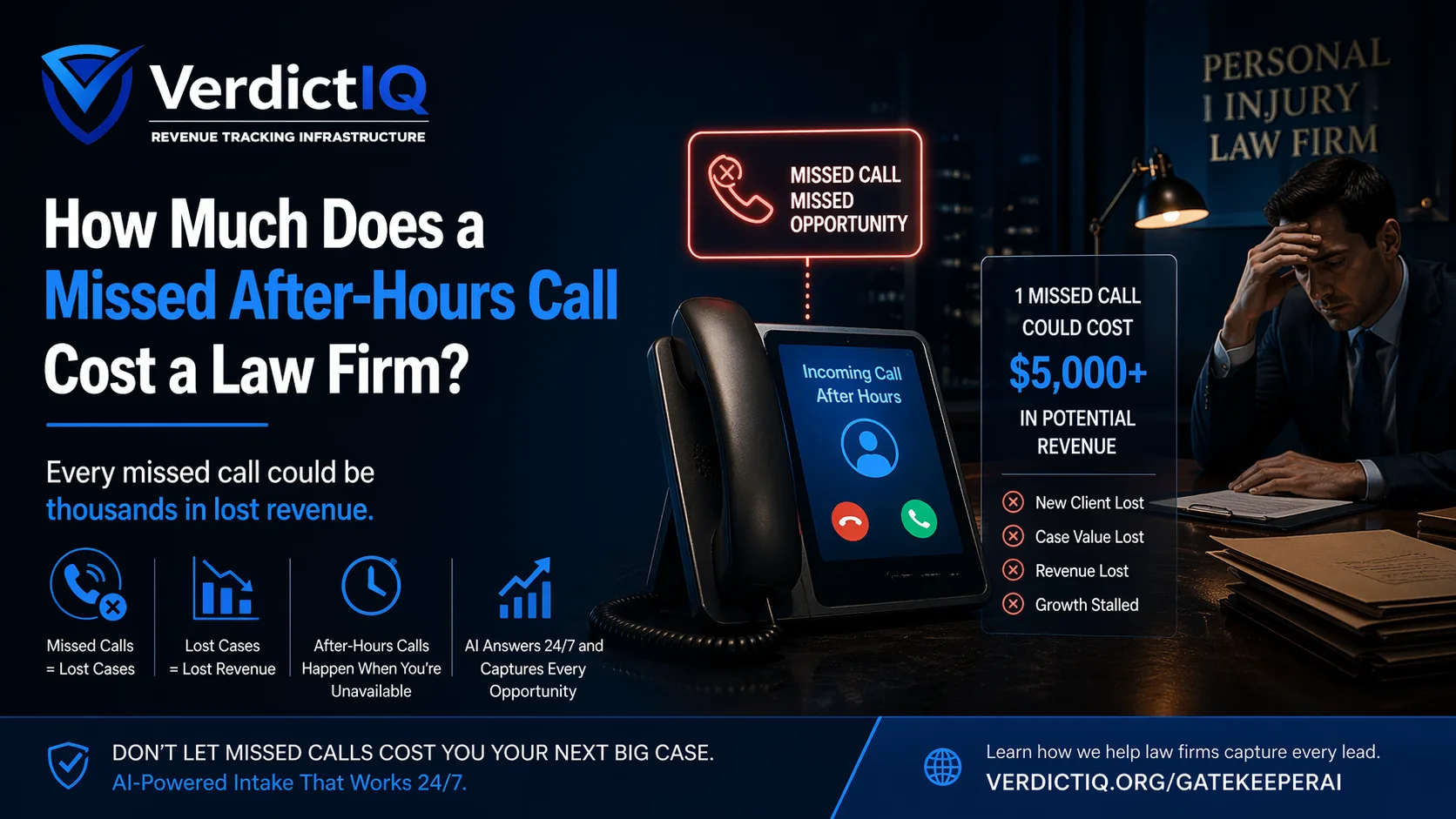
A personal injury lead calls your firm at 7:43 PM on a Tuesday.
They were in an accident three days ago. They are in pain, they are scared, and they are ready to hire an attorney.
Your office is closed.
So they call the next firm on the list.
The Dollar Value of That Call
Most law firms think about missed calls as an inconvenience.
They should think about them as lost revenue.
The math is straightforward. If the average personal injury settlement in your market is $60,000 and your firm works on a 33% contingency, each signed case is worth approximately $20,000 in attorney fees.
The tracking side is not theoretical. Google Ads explains that measuring calls as conversions can connect ad performance to call outcomes, including imported call conversions from another system.
That is the value of one missed call from a qualified lead, before factoring in referrals or the lifetime value of a client who tells three friends about your firm.
For firms receiving 40 to 60 inbound calls per week, missing even one qualified lead per week compounds into more than $1 million in lost annual fees.
When Calls Get Missed
Missed calls do not happen randomly. They cluster in three windows most firms underestimate.
- After hours: evenings, weekends, and holidays when no staff is available. Accidents do not follow business hours. Your intake process does.
- During overflow: when all lines are busy, callers wait an average of 90 seconds before hanging up. Most do not call back.
- During bottlenecks: a single receptionist handling volume will rush, delay, or miss calls during peak hours even when the office is open.
Many inbound legal inquiries arrive outside traditional business hours, because that is when people get home, see the medical bills, and finally have time to call. Personal injury timing makes this worse: car accidents, slip and falls, and workplace injuries happen in the evening and on weekends.
What Voicemail Actually Costs You
Most firms have a voicemail system.
Many callers do not leave a message.
Callers who reach voicemail on an inbound legal inquiry often hang up without leaving a message and contact another firm.
Your after-hours voicemail is not a safety net. Every one of those hang ups is a leak you never see.
The Compounding Problem
It is never one missed call.
A firm receiving 50 inbound calls per week, with 60% arriving after hours, is missing up to 30 calls per week that go to voicemail or ring out unanswered.
If 20% of those callers would have qualified (use your own rate from intake records), that is six potential cases per week disappearing before an attorney ever hears about them.
At $20,000 per case in contingency fees, that is $120,000 in potential revenue per week. Not all of those callers would have signed. But enough of them would have.
And right now, they are signing with your competitors.
Calculate Your Own Missed Call Cost
Use this framework to estimate what after-hours and overflow calls are costing your firm.
- Start with your inbound call volume per week
- Estimate what percentage arrives after hours or during overflow, using your phone system or call tracking report
- Apply your own qualification rate among inbound callers, taken from intake records
- Multiply qualified leads by your average case fee
- That is your weekly missed call cost, before referrals and repeat clients
For most mid-volume personal injury firms, the number lands between $20,000 and $80,000 per week in potential fees that go unanswered.
How Firms Are Fixing It
The solution is not hiring more staff.
It is removing the dependency on staff availability entirely.
AI intake systems answer every inbound call (at 11 PM, on Sundays, during overflow), conduct a real intake conversation, qualify the lead, and book a consultation automatically.
No hold time. No voicemail. No callback list.
A qualified caller goes through intake, gets a booked appointment, and receives a calendar invite before they hang up, regardless of when they called.
Why Faster Follow-Up Does Not Fully Solve the Problem
Many firms try to solve missed calls by calling back faster in the morning. Faster follow-up helps, but it does not undo the competitive reality of the moment. A person who needs a lawyer after an accident is not calmly waiting for office hours. They are searching, comparing, and calling until someone answers.
By the time your staff returns the call, the prospect may already have booked a consultation elsewhere. The missed call has become a missed case not because the firm ignored it forever, but because the firm responded after the decision window closed.
This is why answer rate matters more than voicemail management. A captured call can be qualified, summarized, and booked. A voicemail is only a chance to compete later. The firms that win more intake are designing for the first call, not the callback.
What to Track Before You Add More Marketing Spend
Before increasing ad budget or SEO spend, every firm should know its current intake math. How many calls come in each week? How many are answered live? How many go to voicemail? How many callers leave a message? How many become completed intakes? How many completed intakes become consultations? How many consultations become signed retainers?
If those numbers are unknown, adding more traffic may simply create more leakage. A firm can double paid search spend and still feel flat if the extra calls arrive during overflow or after hours. Marketing can create demand, but intake determines whether the demand becomes a case.
The right sequence is simple: measure call volume, identify missed-call windows, fix answer coverage, then scale acquisition. That is the same logic behind a structured law firm intake process.
The Operational Fix
A durable fix combines three pieces: call tracking, intake coverage, and calendar booking. Call tracking tells you which channels create calls. Intake coverage ensures the call is answered and qualified. Calendar booking turns the qualified caller into a scheduled consultation before they leave the conversation.
If one piece is missing, the system leaks. Call tracking without intake coverage tells you how many calls you missed. Intake coverage without booking still creates a callback list. Booking without tracking creates appointments but leaves the firm unsure which marketing produced them.
GateKeeperAI is designed around all three pieces: answer immediately, qualify consistently, book the consultation, and give the firm a structured summary. If missed calls are showing up in your reporting or you suspect they are, GateKeeperAI is the direct fix.
How to Present the Business Case Internally
If you need buy-in from partners, present missed calls as a capacity and revenue issue, not a technology issue. Show weekly inbound call volume, after-hours percentage, answer rate, and the estimated value of qualified cases that never reached intake. Then compare the cost of improved coverage against the value of one or two recovered cases.
The conversation changes when the firm sees that missed calls are not random. They are a recurring leak in the acquisition system. Fixing that leak often produces more immediate impact than buying more traffic.
What a Better Week Looks Like
In a better intake week, the firm starts Monday with after-hours calls already answered, qualified leads already summarized, and consultations already on the calendar. Staff are not spending the morning chasing voicemails. Attorneys are not entering calls cold. Marketing is not paying for opportunities that disappear before intake.
That operational difference is the real value. The firm is not just answering more calls. It is turning demand into scheduled conversations while the caller is still motivated to act.
That is the difference between having a phone number and having an intake system.
For firms already paying for SEO or ads, that distinction matters immediately because every campaign is only as valuable as the intake process waiting behind it.
That is why missed-call reporting belongs inside a broader search and intake strategy. If your firm wants organic traffic to become signed cases, start with personal injury lawyer SEO built around intake capture.
Final Thought
The cost of a missed call is not an abstract number.
It is a case your competitor is working right now.
The firms growing fastest in competitive PI markets are not outspending on advertising. They are capturing more of the leads they are already generating, by answering every call, at every hour, without exception.
If your firm is ready to stop losing cases to after-hours calls, see how GateKeeperAI handles intake automatically.
Frequently Asked Questions
How much does a missed call cost a law firm?
Many inbound legal leads are never returned quickly, and a large share of inquiries arrive outside business hours. For a personal injury firm where a single signed case may generate $10,000 to $60,000 in fees, even a few missed calls per week can cost hundreds of thousands of dollars annually in lost cases.
Why do law firms miss so many inbound calls?
Most law firm missed calls happen after hours, during lunch, or when staff are occupied with existing clients. Personal injury firms are especially vulnerable because leads are time-sensitive: an injured person who calls and reaches voicemail often calls the next firm on their list immediately.
What is the best way for a law firm to capture after-hours calls?
AI intake systems that answer calls immediately, conduct a real qualification conversation, and book consultations without staff involvement are the most effective solution for after-hours capture. Unlike voicemail, they engage the lead while intent is highest and collect the case facts needed to assess the inquiry before a human reviews it.
How does AI intake reduce missed calls for personal injury firms?
AI intake answers every inbound call regardless of time or staff availability, conducts a structured intake conversation to qualify the lead and gather case facts, and books a consultation automatically. This eliminates the dependency on business hours and staff capacity that causes most missed calls.
Does every missed call represent a lost case?
Not every caller would have qualified, and not every qualified caller would have signed with your firm. But the compounding effect of consistently missing after-hours calls is measurable, and it shows up in case volume over months, not in your call log on any given day.
Is an answering service enough?
Traditional answering services take a message. They cannot qualify leads, conduct an intake conversation, or book a consultation. A caller who speaks to a message-taking service still needs to be called back, which means delay, another window for them to call a competitor, and a callback list your staff works through every morning instead of case work.