
Most law firms spending on Google Ads are flying blind.
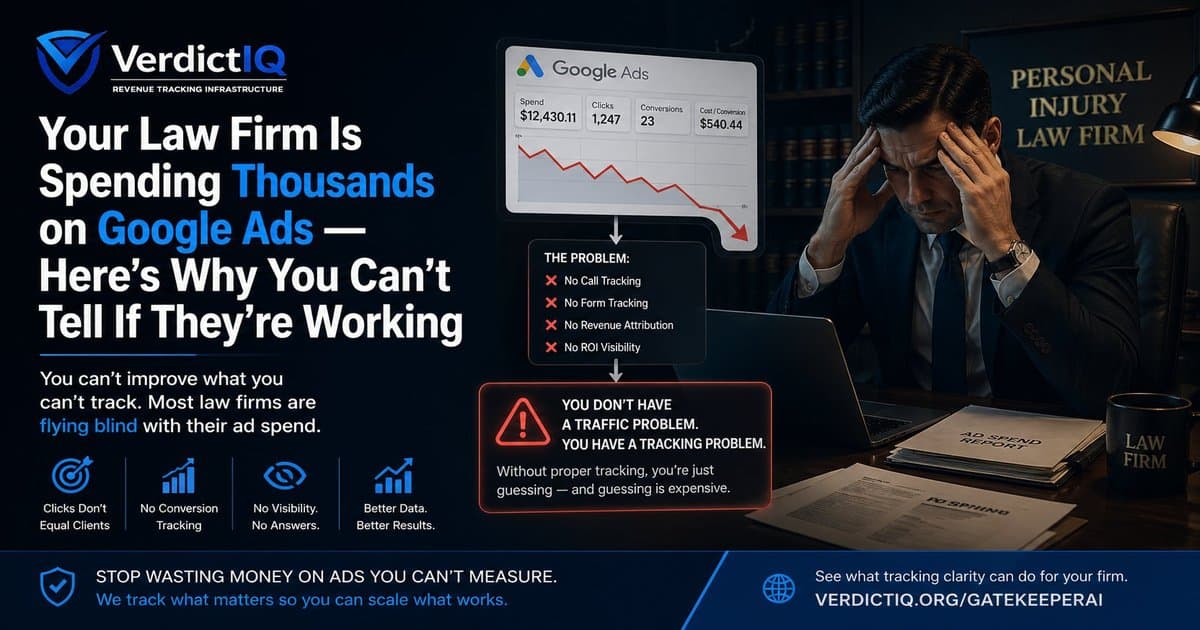
The campaigns are running. The budget is draining. The reporting dashboard shows clicks, impressions, and a cost-per-click number. But when the managing partner asks which campaigns are actually generating signed cases, nobody has a straight answer.
That is not a Google Ads problem. That is a tracking problem. And it is far more common than most agencies will admit.
Google Ads supports more than one conversion method, including website actions, phone calls, and imported outcomes. The official conversion tracking documentation is the baseline a law firm should compare its account setup against.
What 'Conversions' Usually Means in a Law Firm Google Ads Account
When your agency reports conversions, ask them exactly what they are counting. In most law firm accounts, the conversion column includes a combination of:
- Form submissions, which may include spam, wrong-number inquiries, and existing clients
- Phone calls lasting longer than 60 seconds, regardless of whether the caller was a real prospect
- Website sessions from users who previously clicked an ad, not actual contact events
- Button clicks that were mistakenly tagged as conversions during setup
- Duplicate events that fire twice on the same action due to GTM configuration errors
When all of those are lumped together as one conversion number, your cost-per-conversion figure becomes meaningless. A campaign might show 40 conversions at $45 each and actually have generated two qualified inquiries.
Why Call Tracking Alone Doesn't Solve It
Many law firms install a call tracking tool (CallRail, WhatConverts, or similar) and assume the problem is solved. Call tracking is necessary but not sufficient.
The real issue is attribution. When a prospect clicks a Google Ad, visits the site, leaves, searches organically three days later, and then calls, which channel gets credit? Without proper cross-channel attribution built into your tracking layer, that case gets attributed to organic search. Your paid campaign looks like it is underperforming. You cut budget. You lose the cases that were actually driven by the ad.
Call tracking tools record the call. They do not fix the attribution architecture that determines which campaign, keyword, or ad drove the call.
The Five Tracking Failures That Show Up in Almost Every Law Firm Account
- Conversion tags firing on page load instead of on form submission, inflating conversion counts by 3 to 10x
- No separation between new case inquiries and existing client calls in the conversion setup
- Google Ads and GA4 showing different conversion totals because they are measuring different events
- Call conversions counted regardless of call duration or outcome, including calls from other law firms checking your number
- Thank-you page views counted as conversions even when users navigate directly to the URL
What Accurate Law Firm Google Ads Tracking Actually Looks Like
A properly tracked law firm Google Ads account separates conversions into at least three distinct categories:
- Primary conversions: qualified form submissions and phone calls exceeding a meaningful duration threshold (90 to 120 seconds for most practice areas)
- Secondary conversions: shorter calls, chat initiations, and direction requests, tracked but excluded from automated bidding signals
- Imported offline conversions: signed retainers and opened cases imported back into Google Ads so smart bidding can optimize toward actual revenue, not just contact events
That last one, offline conversion import, is what separates firms spending $5,000/month efficiently from firms spending $15,000/month and wondering why it is not working. When Google's algorithm knows which leads actually became clients, it finds more of them. When it is optimizing toward form fills that include spam submissions, it finds more of those.
How to Audit Your Current Setup
Before assuming your campaigns are underperforming, check the data quality. Pull your last 90 days of conversion data and ask:
- Does the conversion count in Google Ads match the number of form submissions in your CRM for the same period?
- Are any conversion events showing suspiciously round numbers or spikes on days with no campaigns running?
- Can you map each converted lead to an actual person who contacted the firm?
- Do your campaigns show higher conversion rates on branded keywords than non-branded, or is it the reverse?
- Is your agency reporting on cost-per-conversion or cost-per-signed-case?
If the answers reveal gaps, the problem is not your ad copy or your budget. The problem is that the measurement layer was never built correctly, and every optimization decision made on top of it has been working from bad inputs.
The Intake Data Your Ads Need
Google Ads tracking does not become useful until it connects to intake. A click is not a case. A form submission is not a case. Even a phone call is not a case until someone qualifies the caller, books the consultation, and the firm signs the client. The farther your reporting stops from that outcome, the more likely you are to optimize toward the wrong signal.
At minimum, a law firm should connect ad campaigns to answer rate, qualified lead rate, booked consultation rate, and signed case outcome. Those stages reveal whether the campaign is producing weak traffic, whether intake is missing calls, or whether consultations are failing to close.
This matters because a campaign can look bad in Google Ads while producing strong signed cases, or look good while producing low-quality inquiries. The difference only appears when ad data is reconciled with intake and CRM data. For firms that are still working from raw call logs and dashboard conversions, that reconciliation is usually the missing layer.
How Bad Tracking Warps Smart Bidding
Smart bidding can be powerful, but it learns from the conversion signals you feed it. If your primary conversion includes spam forms, duplicate events, wrong-number calls, and short accidental clicks, the algorithm will optimize toward more of that behavior. It is not being irrational. It is following the instructions your tracking setup gave it.
The fix is to send cleaner signals. Qualified calls and confirmed consultation requests should be primary conversions. Light engagement events should remain secondary. Signed retainers should be imported offline when possible. When the algorithm sees which leads become real cases, the account can optimize toward value instead of noise.
This is where GA4, GTM, call tracking, and the case management system have to work together. We cover the analytics configuration in the GA4 setup every law firm website needs.
A Monthly Law Firm Ads Tracking Review
Once tracking is rebuilt, it still needs monthly review. Pull the campaigns, conversion events, call outcomes, CRM statuses, and signed cases into one view. Look for mismatches. If a campaign has high spend and high calls but low qualified intake, the keyword intent may be wrong. If it has good qualified intake but low booking, the intake process may need work. If it has booked consultations but low signed cases, the issue may be consultation quality or case fit.
The review should also separate branded and non-branded campaigns. Branded campaigns often look efficient because the prospect already knows the firm. Non-branded campaigns are where growth usually happens, but they need stronger landing pages, sharper intake, and cleaner attribution to evaluate fairly.
For firms expanding organic traffic, the same tracking discipline applies. SEO content can generate cases only if calls, forms, and consultations are measured correctly. That is why law firm SEO, Google Ads, and intake should not be managed as separate silos. They are parts of the same revenue path.
What to Ask Your Agency
Ask your agency which conversion events are primary, which are secondary, and which are excluded from bidding. Ask how phone calls are qualified before they count as conversions. Ask whether signed retainers are imported back into Google Ads. Ask whether branded and non-branded campaigns are reported separately. Ask whether the numbers in Google Ads match the CRM.
A strong agency or technical partner will welcome those questions because they point to better decisions. A vague answer usually means the account is being optimized from surface-level metrics.
The Outcome to Aim For
The goal is not more complex reporting. The goal is a simple line of sight from ad spend to signed cases. When that line exists, the firm can scale the campaigns that produce valuable matters, pause the campaigns that create noise, and fix the intake gaps that prevent good leads from becoming clients.
Until that line exists, every budget increase carries hidden risk. The campaign may be good, but the firm cannot prove it. The campaign may be weak, but the dashboard may hide it. Tracking removes that uncertainty.
Once uncertainty drops, growth decisions get faster and less political.
The firm can stop debating whether ads work in the abstract and start asking which campaigns produce the right cases at the right acquisition cost.
That is the level where optimization finally becomes practical.
What Fixing It Looks Like
Proper law firm Google Ads tracking requires a correctly configured Google Tag Manager container, a validated GA4 property, conversion events that match your actual intake workflow, and a process for importing offline outcomes. That infrastructure is not something a general marketing agency typically builds. It is a dedicated discipline.
VerdictIQ builds this tracking architecture for law firms. If you want to know what your Google Ads are actually generating before your next billing cycle, see how we set up law firm revenue infrastructure.
The same measurement discipline applies to organic search. If your firm wants SEO and ads working from the same revenue scoreboard, start with personal injury lawyer SEO connected to tracking and intake.
Frequently Asked Questions
Why is Google Ads tracking unreliable for law firms?
Most law firm Google Ads tracking counts form fills and page views as conversions, not actual qualified leads or signed cases. If a user calls from a mobile ad, that call may never register as a conversion in your dashboard. The result is a cost-per-conversion number that does not reflect real case acquisition cost.
What conversions should a law firm track in Google Ads?
Law firms should track: inbound phone calls (with a minimum duration threshold, typically 60 to 90 seconds), form submissions with lead source attribution, consultation bookings, and ideally offline conversions from signed cases imported back into Google Ads. Form fills alone significantly overcount real leads.
How do I set up call tracking for law firm Google Ads?
Use Google Ads call extensions with call reporting enabled, or a third-party call tracking tool that dynamically swaps phone numbers per traffic source. Configure a conversion event in GA4 for calls exceeding your minimum duration. Import this as an offline conversion into Google Ads so the algorithm optimizes for calls that actually qualify.
What is the difference between GA4 and Google Ads conversion tracking for law firms?
GA4 tracks user behavior on your website across sessions. Google Ads conversion tracking attributes specific actions to specific ad clicks. For law firms, both should be configured: GA4 for understanding the full user journey, and Google Ads conversion tracking for telling the algorithm which clicks led to real intake events. They serve different optimization purposes.