

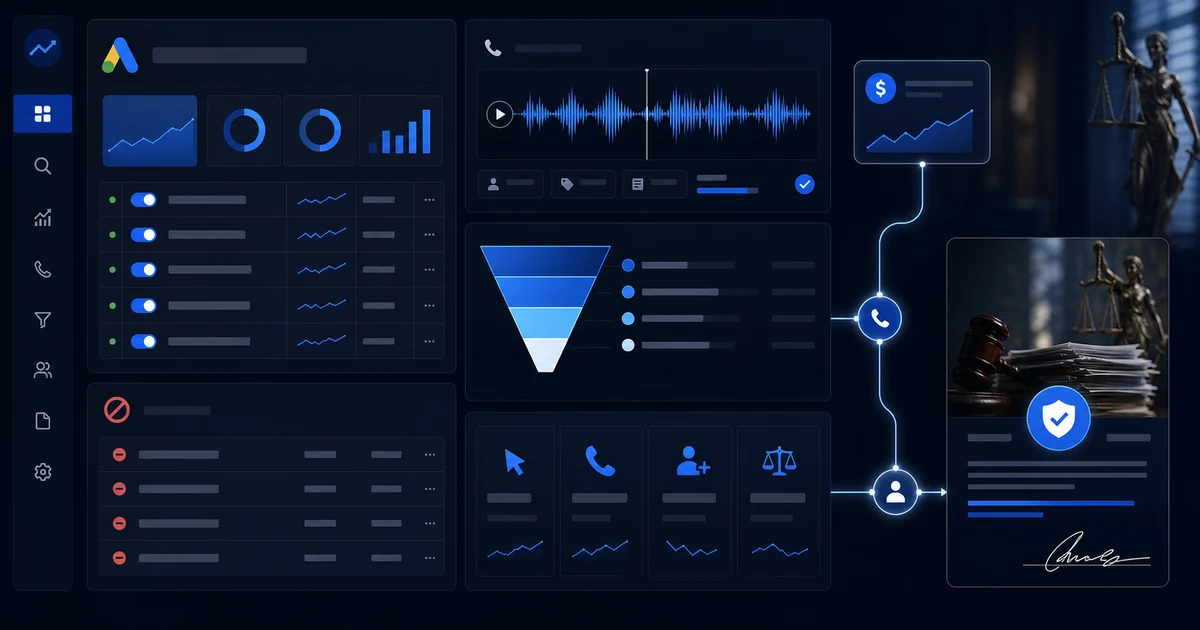
A law firm PPC audit is the fastest way to find whether Google Ads and Local Services Ads are creating real case opportunities or just expensive activity. The audit should inspect campaigns, keywords, search terms, conversion actions, call tracking, landing pages, intake outcomes, and signed-client attribution. If it stops at clicks, impressions, and a generic cost-per-lead number, it is not a serious audit.
This guide explains how VerdictIQ audits paid search for law firms, why the highest-risk problems usually sit outside the ad platform, and how to decide what to fix first. If you need the service layer behind this article, start with our law firm PPC and Google Ads page. If the issue is broader measurement trust, the revenue infrastructure page explains the tracking foundation.
Why a Law Firm PPC Audit Is Different
Legal PPC is not like ecommerce or low-ticket lead generation. One signed case may be worth more than a month of clicks, while dozens of cheap leads may be worthless if they are wrong practice areas, duplicate contacts, spam, job seekers, or callers outside the firm's geography. That means the audit cannot judge performance by platform conversions alone. It has to follow the path from search query to consultation to signed matter.
Most bad law firm PPC accounts do not fail because nobody knows how to write ads. They fail because the account is optimizing toward the wrong signals. Google Ads may see a form submit, a short phone call, or an accidental button click as a conversion. The intake team may know that same lead was unqualified, but that information never returns to the campaign. The ad platform keeps buying more of the same behavior because the firm accidentally taught it that noise was success.
A good audit therefore has two jobs. First, it finds technical waste inside the campaign: broad matches that are too loose, missing negative keywords, weak location controls, duplicate campaigns, low-intent queries, poor ad-to-page alignment, and conversion actions that should not be primary goals. Second, it finds business waste outside the campaign: unanswered calls, intake scripts that miss qualification details, CRM statuses that do not sync back to marketing, and reports that cannot separate signed cases from general leads.
Start With the Question the Partners Actually Care About
The right first question is not whether PPC is working. It is which parts of PPC are producing qualified consultations and signed cases at a cost the firm can defend. That framing changes the audit. A campaign with a high cost per click may be profitable if it produces serious injury cases. A campaign with a low cost per lead may be harmful if most leads are out of state, low value, or never answered by intake.
Before touching settings, write down the firm's actual economic threshold. What practice areas are profitable? What case types should the campaign exclude? What is a qualified consultation? Which inquiries should never count as conversions? How quickly must calls be answered? What is the maximum acceptable cost per signed case by practice area? Without those answers, an audit becomes a list of opinions instead of a decision tool.
VerdictIQ treats this as a measurement problem first. Paid search needs a clean connection between Google Ads, landing pages, call tracking, forms, calendar bookings, CRM statuses, and signed-client outcomes. The campaign manager should not have to guess whether a conversion was useful. The data should show whether the lead became a qualified consultation, whether the consultation happened, and whether the matter signed.
The Seven-Part Law Firm PPC Audit Framework
A practical law firm PPC audit should move from account structure to revenue proof. The exact platform mix may include Google Ads search campaigns, Local Services Ads, remarketing, call-only ads, landing pages, and offline conversion imports. The audit sequence below keeps the work focused on the places where money usually leaks.
| Audit area | What to inspect | Why it matters |
|---|---|---|
| Campaign intent | Practice areas, geography, match types, search terms, budgets | Spend should go to cases the firm actually wants |
| Conversion tracking | Primary actions, call duration rules, duplicate events, form quality | Bad conversion data trains the account to buy bad leads |
| Call tracking | Source numbers, call recordings, missed calls, qualified-call labels | Phone leads often carry the highest case value |
| Landing pages | Message match, speed, mobile click paths, form friction, trust signals | High-intent clicks still fail when the page creates hesitation |
| Local Services Ads | Lead quality, disputes, categories, profile completeness, booking flow | LSAs can work well only when lead quality is reviewed closely |
| Intake handoff | Answer rate, speed to lead, scripts, qualification, follow-up | Paid demand is wasted if the firm cannot convert it |
| Revenue attribution | Consultations, signed cases, case type, value, source integrity | The firm needs cost per signed case, not just cost per lead |
Audit Paid Search Before You Change Bids
Google Ads for law firms gets expensive when bidding changes happen before the account has clean evidence. A lower target cost per lead will not fix a campaign that is buying the wrong searches. A larger budget will not fix duplicate conversions. A new landing page will not help if the firm never knows which calls became qualified consultations. The audit should prove what Google is optimizing toward before anyone changes bidding strategy.
Start with the campaign's primary conversion actions. If every phone tap, short call, chat start, and form submit is marked as a primary goal, the account is telling Google that all leads are equally valuable. That is rarely true for legal PPC. A serious injury consultation, a wrong-number call, a solicitor, and a caller outside the service area should not carry the same optimization weight. The audit should separate business outcomes from tracking events.
Then compare search-term intent against signed-case value. Some expensive queries are worth keeping because they indicate urgent legal need. Some cheap queries should be excluded because they attract research, jobs, forms, vendors, or cases the firm does not want. This is where a law firm PPC audit protects budget: it connects the phrase someone searched to the matter the firm actually wants to sign.
| PPC signal | Common audit finding | Better decision |
|---|---|---|
| High clicks, few qualified calls | The keyword or landing page attracts research intent | Tighten match types, negatives, and page message match |
| Many short calls | Calls are counted before qualification | Raise call-duration rules and review call outcomes |
| Low cost per lead | The account counts weak form fills as conversions | Import qualified consultation or signed-case milestones |
| Strong calls, few signed cases | Intake is losing paid demand after the click | Fix answer rate, routing, scripts, and follow-up |
| Automated bidding swings | The algorithm is learning from polluted goals | Clean primary goals before changing bid strategy |
Audit Campaign Structure Before You Audit Performance
Campaign structure determines whether the account can make clean decisions. If one campaign mixes personal injury, criminal defense, family law, brand terms, competitor terms, broad legal information queries, and retargeting audiences, the performance report will be blurry. The firm may know total spend and total leads, but it will not know which intent is profitable.
Start by mapping every campaign to a business purpose. A personal injury firm might separate car accident, truck accident, premises liability, wrongful death, and brand protection. A criminal defense firm might separate DUI, domestic violence, drug charges, and emergency arrest queries. Each campaign should have a defined geography, budget, landing page, conversion goal, and negative keyword logic. If those boundaries do not exist, the audit should flag structure before it debates bid strategy.
Then inspect search terms, not just keywords. Keywords are what the firm asked Google to target. Search terms are what people actually typed. Waste usually appears there first: legal jobs, free advice, forms, definitions, unrelated jurisdictions, attorney salary searches, law school searches, government pages, and people trying to contact a different firm. Google's negative keyword documentation explains the basic exclusion mechanism, but legal accounts need a disciplined review habit, not a one-time list.
Check Whether Conversion Tracking Is Lying
Conversion tracking is where many PPC audits become uncomfortable. The account may show a healthy number of conversions while the partners feel no business impact. That conflict is a signal. It usually means the account is counting actions that are easy to measure instead of actions that reflect qualified demand.
Open the conversion goals and classify each action as primary, secondary, or diagnostic. Primary actions should be serious business events: qualified calls, qualified form submissions, booked consultations, or imported signed-case milestones where the firm has enough data quality to support them. Secondary actions can include click-to-call taps, page engagement, chat starts, and lightweight forms. Diagnostic events are useful for troubleshooting but should not steer bidding.
Phone calls deserve special attention. Google Ads supports phone call conversion tracking for calls from ads, calls to numbers on a website, and clicks on phone numbers on mobile sites. Google's phone call conversion tracking documentation is useful, but the audit still has to decide what counts as a qualified legal call. A five-second wrong number should not carry the same weight as a six-minute case evaluation call.
Look for duplicate events. It is common to find the same form counted through a thank-you page, a Google Tag Manager event, a GA4 import, and a Google Ads tag. It is also common to find chat widgets firing conversions before anyone knows whether the chat was real. Duplicate or premature conversion actions inflate results and teach automated bidding to chase low-quality interactions.
Listen to Calls, Not Just Call Counts
For law firms, calls are often the most valuable lead type and the least understood. A PPC report may show call volume, call duration, and cost per call. That is a start, but it does not answer whether the calls were answered, qualified, booked, followed up, and signed. A law firm PPC audit should review a sample of call recordings or call summaries where consent and jurisdictional requirements allow it.
Classify the sample. Was the call answered live? Was it a viable case type? Was the caller inside the service area? Did the caller need a lawyer now or general information? Did intake collect the right details? Was the consultation booked? Did the call source appear correctly in the CRM? That review often reveals that the account is not the only problem. Sometimes the firm is buying valid demand and losing it during intake.
This is why VerdictIQ connects PPC to intake and attribution instead of treating ads as an isolated channel. A campaign cannot fix an unanswered call. It cannot fix a receptionist who fails to ask the right qualifying questions. It cannot fix a CRM field that loses source data. The audit should name those issues because they determine whether ad spend turns into revenue.
Review Local Services Ads Separately
Local Services Ads need their own audit path. They are not simply another search campaign. Google describes Local Services Ads as a way for businesses to receive leads directly through calls and messages, with lead management inside the platform. For legal categories, profile setup, screening, review quality, service categories, responsiveness, and lead disputes can all affect efficiency. Google's Local Services Ads documentation is the operational baseline.
Audit LSA lead quality by category and by outcome. Are leads coming from the practice areas the firm wants? Are there disputes that should have been filed? Are leads being answered quickly enough? Are messages sitting unhandled? Are profile categories too broad? Are reviews and business information complete? A firm can spend heavily in LSAs while missing the management habits that keep pay-per-lead pricing useful.
LSA reporting should still connect back to the same business questions as Google Ads. Which lead types became consultations? Which consultations signed? Which categories produce matters worth scaling? Which geographies or case types should be excluded? If LSAs live in a separate dashboard and never touch the firm's source-of-truth reporting, the partners are still guessing.
Audit the Landing Page Like an Intake Room
A paid-search landing page is not a brochure. It is the room where a high-intent prospect decides whether to call. The page has to match the query, load quickly on mobile, make the phone number obvious, explain the case type, establish trust without overclaiming, and remove friction from the next step. If someone searches for a truck accident lawyer and lands on a generic firm homepage, the campaign is paying for hesitation.
Check message match first. The ad, keyword, and landing page should agree on practice area, geography, and urgency. Then check mobile behavior at 375px width. Is the click-to-call button visible? Does the form fit without awkward scrolling? Are tap targets usable? Does the page introduce enough trust before asking for contact information? Does the copy avoid unsupported guarantees or misleading claims?
Legal advertising rules matter here. State bar versions of Rule 7.1 commonly prohibit false or misleading communications about a lawyer's services. The North Carolina Rule 7.1 text is a useful example and reminder that conversion copy still needs restraint. A high-converting legal landing page should be specific, credible, and easy to act on, not aggressive in a way that creates compliance risk.
Separate Waste From Scale Problems
Not every bad PPC number means the account should be cut. Some problems are waste problems. Others are scale problems. Waste means the account is spending on the wrong searches, counting the wrong conversions, sending traffic to weak pages, or losing source data. Scale means the account has found valid demand but needs more budget, better landing pages, stronger intake coverage, or more precise bidding to grow profitably.
The audit should classify every finding by action. Pause, rebuild, measure, test, or scale. A campaign buying irrelevant search terms may need a pause and negative keyword cleanup. A high-intent campaign with missed calls may need intake coverage before budget increases. A landing page with strong calls but poor form submissions may need UX changes. A campaign with signed cases but incomplete offline import may need attribution repair so bidding can learn from the right outcomes.
This prevents the common overreaction of either killing PPC too early or increasing spend too soon. A firm should not scale a campaign with untrusted conversion data. It also should not abandon a campaign that is generating good calls but exposing an intake bottleneck. The audit's job is to make that distinction visible.
What a Useful PPC Audit Report Should Include
A useful report is not a 60-page export from Google Ads. It should give the firm a prioritized decision list. Each issue should name the evidence, the business risk, the fix, the expected impact, and the owner. Partners should be able to see which problems are wasting money now, which problems are limiting growth, and which problems are reporting gaps that make future decisions harder.
- A campaign map showing every campaign, practice area, geography, budget, landing page, and primary goal.
- A search-term waste review with the highest-spend irrelevant or low-intent queries.
- A conversion action audit that labels each goal as primary, secondary, duplicate, or diagnostic.
- A call-quality review that separates answered, missed, qualified, unqualified, booked, and signed outcomes.
- A Local Services Ads review covering categories, disputes, responsiveness, profile completeness, and lead outcomes.
- A landing-page review focused on mobile speed, message match, trust, click-to-call access, and form friction.
- A first-30-days fix plan that prioritizes measurement integrity before budget expansion.
The report should also say what not to do. Do not move to automated bidding if conversion data is polluted. Do not increase budget because cost per lead looks low when lead quality is unknown. Do not judge LSAs only by lead count. Do not launch new practice areas before the existing ones have clean tracking. Good restraint saves more money than clever tactics.
The First 30 Days After the Audit
The first month after a law firm PPC audit should be practical. Fix the measurement foundation first: clean duplicate conversion actions, define qualified-call thresholds, label primary and secondary goals, connect forms and calls to source data, and decide how offline outcomes will be recorded. If the firm has a CRM or case management system, create simple statuses that marketing can use without disrupting intake.
Then clean demand quality. Add negative keywords from the search-term review, split campaigns that mix unrelated intent, tighten geography, pause wasteful ad groups, and match landing pages to the case types that matter. If Local Services Ads are active, review lead disputes weekly and make sure messages and calls are handled quickly.
Finally, set a review cadence. Weekly reviews should focus on spend, search terms, conversion quality, missed calls, and urgent budget decisions. Monthly reviews should focus on consultations, signed cases, cost per signed case, and what should scale. That rhythm turns PPC from a vendor report into an operating system for growth.
How VerdictIQ Audits Law Firm PPC
VerdictIQ audits paid search from the campaign to the signed case. We inspect Google Ads and Local Services Ads, but we also inspect the tracking layer, call flow, landing page, intake handoff, and reporting model. That is the difference between finding cheaper clicks and finding profitable case acquisition.
The work usually connects to three VerdictIQ systems. The law firm PPC service handles the paid-search strategy. Revenue infrastructure fixes the attribution layer that tells the truth about performance. GateKeeperAI helps protect the demand PPC creates by answering, qualifying, and booking leads when the front desk is unavailable or overloaded.
If your firm is spending on Google Ads but cannot say which campaigns created signed cases, start with an audit before changing budget. The fastest win may be a campaign fix, a tracking fix, a landing-page fix, or an intake fix. The point is to find the real constraint before another month of ad spend hides it.
Frequently Asked Questions
What is a law firm PPC audit?
A law firm PPC audit reviews campaigns, search terms, conversion tracking, call quality, landing pages, Local Services Ads, intake handoff, and signed-case attribution to find wasted spend and missed growth opportunities.
How often should a law firm audit Google Ads?
A full audit is useful every quarter or after a major spend increase, practice-area launch, landing-page change, or intake system change. Search terms and lead quality should be reviewed weekly.
What is the most common PPC tracking problem for law firms?
The most common problem is counting every form submit, short call, chat start, or click-to-call tap as a primary conversion even when intake data shows many of those actions are not qualified leads.
Should PPC be measured by cost per lead or cost per signed case?
Cost per lead is useful only as an early signal. Law firms should ultimately judge PPC by cost per qualified consultation and cost per signed case because lead volume alone does not prove revenue.