

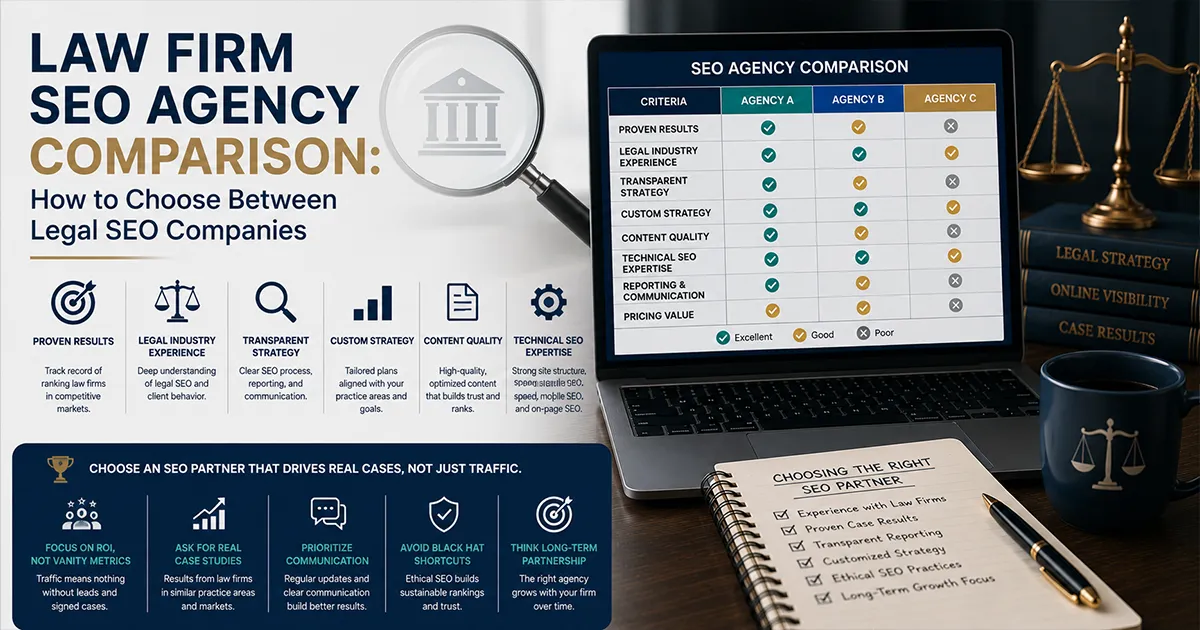
A law firm SEO agency comparison should not start with who promises the most rankings.
It should start with what the firm actually needs: better search visibility, clearer practice-area pages, stronger local signals, measurable calls, booked consultations, and signed cases that can be traced back to organic demand.
That is a different buying process than comparing retainers on a spreadsheet. Two legal SEO companies can both say they handle keyword research, content, links, technical SEO, and reporting. One may be building a real search-to-case system. The other may be publishing generic articles and sending rank screenshots.
The labels sound similar. The outcomes are not.
This guide gives attorneys a practical way to compare law firm SEO agencies before signing a contract. It is not a vendor takedown or a ranking of agencies. It is a due diligence checklist for deciding whether a legal SEO partner can connect search demand to qualified consultations and signed clients.
If you are still trying to understand budget, start with the law firm SEO cost guide. If you are focused on a competitive injury market, read the personal injury lawyer SEO service page and the personal injury lawyer SEO guide. This article is the selection layer: how to compare providers once you know SEO is on the table.
What a Law Firm SEO Agency Comparison Should Measure
A useful law firm SEO agency comparison measures the parts of SEO that affect business outcomes.
That means comparing strategy, technical execution, content quality, local SEO, authority building, reporting, conversion tracking, intake alignment, communication, and pricing. Rankings are part of the picture, but they are not the whole picture.
A firm can rank for low-value informational terms and still get no cases. It can get more organic traffic and still miss calls. It can publish more blog posts and still have weak service pages. It can receive beautiful monthly reports and still have no idea which organic leads became signed clients.
The agency comparison should answer one central question: will this provider help us build an organic acquisition system, or are they only selling SEO activity?
Start With the Firm's Actual Growth Problem
Before comparing agencies, define the problem you are hiring them to solve.
Some firms need technical cleanup because Google is struggling to crawl, index, or understand the site. Some need service-page architecture because the site has no strong pages for its main practice areas. Some need local SEO because Maps visibility is weak. Some need content depth because competitors have stronger guides, FAQs, attorney profiles, and location pages.
Other firms do not have a pure SEO problem. They have an intake problem. They get organic calls, but nobody answers quickly. They get forms, but follow-up is slow. They get consultations, but source tracking is missing. In those cases, hiring an SEO agency without fixing intake may produce more leakage, not more growth.
A good agency should help diagnose that. If every sales call turns into the same package regardless of your market, site, rankings, content, reviews, call tracking, and intake process, the comparison should get more skeptical.
Compare Strategy, Not Just Services
Most SEO proposals list services.
Services are useful, but they are not a strategy. Keyword research, blog writing, technical SEO, link building, local SEO, and reporting only matter if they fit together around a clear market opportunity.
Ask each agency to explain the first 90 days. Not in vague language. Ask what they will inspect, what they expect to change, what pages they will prioritize, what technical issues they will look for, what metrics they will baseline, and how they will decide whether to create new content or improve existing pages.
A strong strategy should identify the firm's highest-value practice areas, current ranking gaps, local market competition, technical constraints, content gaps, internal-link opportunities, conversion paths, and measurement setup.
A weak strategy sounds like this: we will optimize keywords, post blogs, build links, and send reports. That may be activity, but it does not show that the agency understands the firm's market or revenue path.
Compare Legal SEO Experience Carefully
Legal SEO is not the same as generic local SEO.
Law firms compete in markets where trust, jurisdiction, practice-area detail, attorney credibility, reviews, local relevance, and intake speed all matter. A page about car accidents, divorce, criminal defense, immigration, or probate cannot be treated like a generic service page for a home services company.
A legal SEO agency should understand how people search before contacting a lawyer. They should know the difference between practice-area pages, city pages, case-type pages, attorney bios, FAQ content, local pack visibility, and supporting blog articles.
They should also understand legal marketing sensitivity. They should avoid fake guarantees, fabricated case results, copied content, misleading claims, or content that drifts into legal advice. The point is not to make the writing timid. The point is to keep it accurate, useful, and aligned with the firm's rules.
How to Compare Inoriseo vs Juris Digital Without Turning It Into a Popularity Contest
Some attorneys compare specific vendors directly, such as Inoriseo vs Juris Digital, because both appear in the legal SEO conversation.
That kind of comparison can be useful if it stays focused on fit. It becomes less useful when it turns into a brand preference contest or a list of surface-level claims.
Use the same scorecard you would use for any legal SEO company. Review each provider's own positioning, case studies, service pages, pricing transparency, deliverables, reporting philosophy, communication style, technical depth, content approach, local SEO process, and ability to connect SEO work to intake outcomes.
For example, review each provider's public material directly, such as Inoriseo's comparison page and Juris Digital's comparison hub. Then verify what matters for your firm instead of accepting any vendor's framing at face value.
The right question is not, "Which agency sounds better?" The right question is, "Which partner can prove they understand our market, our practice areas, our intake process, our reporting needs, and our path to signed cases?"
Compare Deliverables Line by Line
The deliverables section is where many SEO proposals become fuzzy.
One agency may include technical implementation. Another may only provide recommendations for your developer. One may rewrite service pages. Another may only publish blog posts. One may handle local SEO and Google Business Profile updates. Another may consider that outside scope. One may configure call tracking and conversion events. Another may report only rankings and traffic.
Put each proposal into a simple comparison table with these rows:
- Technical audit and implementation
- Practice-area page optimization
- New service pages or location pages
- Blog or resource content
- Internal linking
- Local SEO and Google Business Profile support
- Citation cleanup
- Digital PR or link earning
- Schema markup
- Page speed and Core Web Vitals work
- Call tracking and form tracking
- GA4 and Google Search Console reporting
- CRM or intake outcome reporting
- Monthly strategy and communication cadence
Then ask who actually does each item. Is it included? Is it a recommendation only? Is it outsourced? Is it limited to a certain number of hours? Is it billed separately?
The cheapest proposal may not be the cheapest once missing implementation, content, tracking, and development work are added back in.
Compare Content Quality Like a Prospective Client Would
Content quality is one of the easiest things for attorneys to inspect before hiring an SEO agency.
Ask for examples of pages the agency wrote or improved. Read them like a prospective client. Do they answer real questions? Do they explain the legal issue clearly without overpromising? Do they show the firm's experience? Do they connect to the next step? Do they sound like a thoughtful legal resource or like a keyword assignment?
Google's helpful content guidance emphasizes people-first content. For law firms, that means pages should answer the prospective client's question, clarify what happens next, and make the firm easier to evaluate.
Thin legal content usually has a familiar feel. It defines the practice area in generic terms, repeats the city name too often, lists obvious benefits, and ends with a vague call to action. Stronger content explains the decision the reader is trying to make, the facts that matter, the process ahead, common pitfalls, and how the firm evaluates fit.
For competitive personal injury topics, content also needs structure. A single broad personal injury page is rarely enough. It should connect to supporting pages like car accident lawyer SEO, local SEO, intake coverage, and case-type content.
Compare Technical SEO Depth
Technical SEO is where a polished sales pitch can hide a shallow process.
Ask each agency how they audit crawlability, indexation, canonical tags, redirects, internal links, schema, site speed, mobile usability, JavaScript rendering, duplicate pages, thin pages, sitemap hygiene, and robots.txt rules.
Google's SEO Starter Guide is a useful baseline because it shows how many fundamentals have to work before content can perform well. For law firms, those fundamentals matter even more when the site has multiple practice areas, locations, blog archives, attorney bios, and tracking scripts.
The agency should be able to show examples of technical issues they have fixed, not just issues they have reported. Recommendations are useful, but implementation is what changes the site.
Compare Local SEO and Google Business Profile Work
For many law firms, local SEO is not optional.
The local pack can be one of the most valuable parts of the search results page. A legal SEO partner should understand Google Business Profile categories, services, reviews, photos, business details, local landing pages, citations, and proximity-sensitive search behavior.
Google's local ranking documentation explains that relevance, distance, and prominence influence local results. An agency cannot control every local ranking factor, but it should know how to improve the parts the firm can influence.
Ask how the agency handles reviews, service descriptions, business details, local citations, location-page content, and local reporting. Also ask what they will not do. Review spam, fake locations, and misleading local pages can create more risk than value.
Compare Reporting by Business Outcome
A law firm SEO agency should report more than rankings.
Rankings matter because they show directional progress. Traffic matters because it shows whether visibility is creating visits. But neither metric proves that SEO is creating qualified opportunities.
Ask each agency how they report:
- Organic landing pages
- Queries and impressions in Google Search Console
- Organic calls
- Form submissions
- Qualified leads
- Booked consultations
- Show rate
- Signed clients
- Cost per signed client
- Practice-area performance
Google Search Console's performance report can show clicks, impressions, CTR, and average position. That is valuable, but it stops before intake. A serious reporting setup connects GSC and GA4 with call tracking, forms, calendars, and CRM or intake statuses.
That is the difference between SEO reporting and revenue reporting. SEO reporting says visibility improved. Revenue reporting shows whether visibility created qualified consultations and signed cases.
Compare Pricing Against Scope
Price only makes sense when compared against scope.
A lower monthly retainer may be reasonable for maintenance or a less competitive market. It may be underpowered for a personal injury firm trying to compete in a major city. A higher retainer may be justified if it includes strategy, technical implementation, content production, local SEO, authority building, conversion tracking, and reporting. It may be wasteful if it only buys meetings and dashboards.
This is why the law firm SEO pricing guide should be read with the agency comparison in mind. The question is not whether an agency is cheap or expensive. The question is whether the scope matches the market, the practice area, and the revenue target.
If two proposals are priced similarly but one includes technical implementation, call tracking, content strategy, local SEO, and signed-case reporting while the other includes blogs and rank reports, they are not equivalent offers.
Compare Communication and Ownership
A good SEO campaign needs ownership.
Ask who will be responsible for strategy, technical changes, writing, editing, reporting, and client communication. Ask whether you will work with senior strategists or only account managers. Ask how often the roadmap is reviewed. Ask how decisions are made when rankings stall.
The agency should be able to explain what happened last month, what is happening this month, what is blocked, what changed in the data, and what they recommend next.
If the monthly meeting is mostly a dashboard walkthrough, the firm may not be getting strategic guidance. A useful SEO partner should bring decisions to the table, not just metrics.
Red Flags When Comparing Legal SEO Companies
Some warning signs are obvious. Others hide behind polished proposals.
- Guaranteed rankings for competitive legal terms
- No explanation of what will change on the site
- Generic blog topics with no practice-area strategy
- No technical implementation plan
- No local SEO process
- No call tracking or form tracking
- Reports that stop at traffic and rankings
- No connection to intake outcomes
- No clear content review process
- No discussion of market competition
- No answer for how signed-case ROI will be measured
The biggest red flag is certainty without evidence. SEO involves competition, search behavior, technical constraints, content quality, authority, and time. A good agency can explain its process and show why the plan is reasonable. It should not pretend it controls Google.
Questions to Ask Before Hiring a Law Firm SEO Agency
Use these questions before signing a contract:
- Which practice areas and markets would you prioritize first?
- What technical issues will you audit in the first month?
- Which existing pages would you improve before creating new pages?
- What new pages or articles do you believe we need and why?
- How do you decide between a service page, location page, and blog post?
- How will you improve internal linking?
- How will you handle Google Business Profile and local SEO?
- What external authority or link-earning work is included?
- Who writes and reviews legal content?
- How will calls, forms, consultations, and signed clients be tracked?
- What does the monthly report include?
- What would make you recommend pausing, changing, or expanding the campaign?
The answers should be specific. If an agency cannot explain its plan without leaning on jargon, the firm may struggle to understand what it is paying for after the contract starts.
When a Comparison Should Lead to a Refresh Instead of a New Vendor
Sometimes the agency comparison reveals that the current provider is not the main problem.
A firm may already have a capable SEO partner, but the campaign is underfunded, approvals are slow, intake data is missing, attorneys are not reviewing content, or the website platform makes implementation painful. In that case, switching agencies may reset the relationship without fixing the bottleneck.
Before replacing a provider, identify whether the missing piece is strategy, execution, reporting, content review, technical access, local authority, or intake measurement. If the agency has a sound plan but cannot get decisions, data, or implementation access, the better move may be a campaign reset. If the agency cannot explain the plan, ship meaningful work, or connect SEO to business outcomes, then a new partner is easier to justify.
A Simple Law Firm SEO Agency Scorecard
A scorecard keeps the comparison fair.
Score each agency from one to five in these categories:
- Legal market experience
- Practice-area strategy
- Technical SEO depth
- Content quality
- Local SEO process
- Authority and link strategy
- Conversion tracking
- Intake outcome reporting
- Communication clarity
- Pricing transparency
- Implementation ownership
Then add notes. A slightly lower score may still be acceptable if the agency is strong in the areas your firm needs most. A high score in content may not matter if the site has serious technical problems. A strong technical partner may not be enough if the firm needs local SEO and intake reporting.
The scorecard prevents the decision from becoming emotional. It also helps partners compare options without relying only on the best sales call.
When VerdictIQ Is the Better Fit
VerdictIQ is not trying to be a traditional SEO agency that only publishes content and reports rankings.
VerdictIQ is built around the full path from visibility to revenue: search strategy, AI visibility, technical SEO, website conversion, tracking architecture, call capture, intake automation, and reporting that connects demand to business outcomes.
That matters for law firms because SEO rarely fails in only one place. A firm may need better pages, but it may also need better tracking. It may need more impressions, but it may also need faster intake. It may need better local visibility, but it may also need a stronger way to measure which calls became signed clients.
For firms that want that broader system, start with revenue infrastructure, AI visibility for law firms, or GateKeeperAI if the immediate leak is intake coverage.
Final Thought
The best law firm SEO agency is not the one with the flashiest ranking promise.
It is the one that can explain how your firm will become easier to find, easier to trust, easier to contact, and easier to measure from first search to signed client.
Compare agencies by the system they build, not the keywords they name. Look for clear strategy, real implementation, strong legal content, local SEO depth, clean reporting, and a plan for connecting organic visibility to intake outcomes.
If you want a law firm growth partner focused on signed-case measurement instead of vanity rankings, book a VerdictIQ strategy call and we will map the search, tracking, and intake gaps that should guide your next SEO decision.
Before comparing individual agencies, it is worth settling which kind of provider you are comparing at all. The five delivery models compared covers in-house, freelance, generalist, legal specialist and engineering led, and where each one tends to break.