

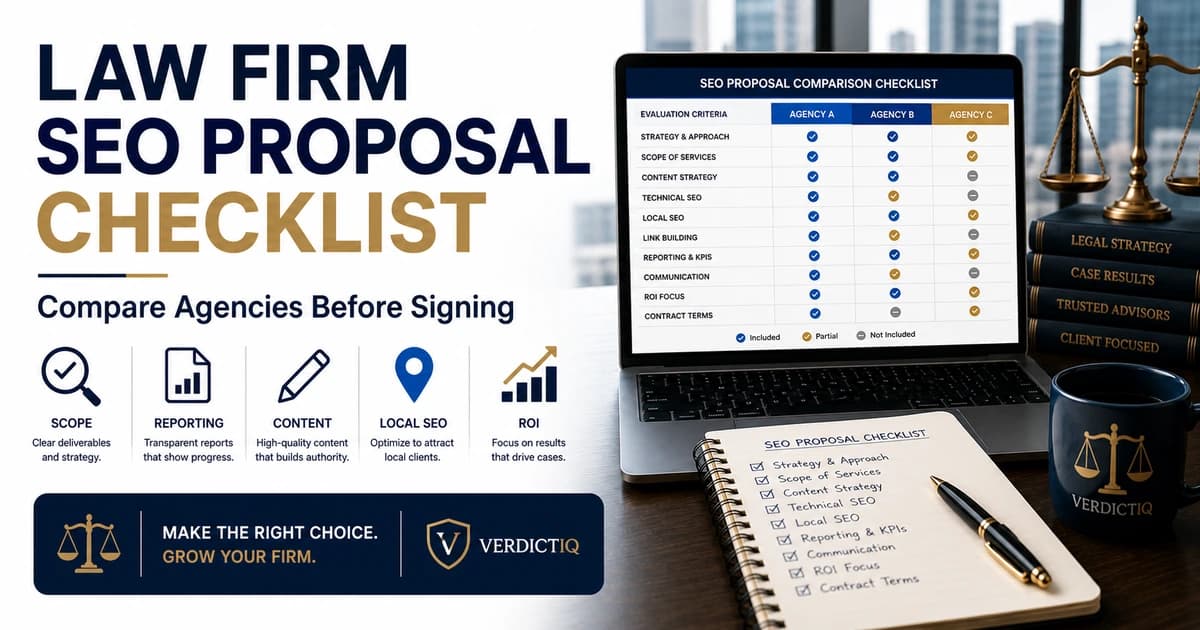
A law firm SEO proposal checklist helps attorneys compare agencies before they sign a retainer, but the checklist has to go deeper than price. The proposal may look professional, the sales call may sound confident, and the deliverables may use familiar SEO language. That does not mean the scope is strong enough to produce qualified consultations or signed cases.
The problem is that most law firm SEO proposals sound similar on the surface. They mention keyword research, content, technical SEO, local SEO, links, reporting, and monthly strategy. But one proposal may include real implementation and signed-case tracking while another only includes recommendations, generic blogs, and rank screenshots.
This guide gives attorneys a practical way to compare law firm SEO agencies before signing a monthly retainer. It is intentionally different from the broader law firm SEO agency comparison guide. That article explains how to evaluate providers. This one focuses on the actual proposal: what should be in it, what questions to ask, what red flags to catch, and how to connect the retainer to revenue.
Why Law Firm SEO Proposals Are Hard to Compare
Law firm SEO proposals are hard to compare because agencies package different work under the same labels. One provider may say "content strategy" and mean a full practice-area architecture, search intent map, content briefs, attorney review process, internal links, and conversion paths. Another may use the same phrase to mean two short blog posts per month.
The same thing happens with technical SEO. A strong proposal may include crawlability fixes, schema cleanup, redirect repair, canonical review, internal-link improvements, Core Web Vitals work, sitemap hygiene, and developer coordination. A weak proposal may only include a scan from an SEO tool and a PDF of recommendations the firm has to implement itself.
Price alone cannot solve that problem. A lower retainer can be reasonable when the scope is narrow and honest. A higher retainer can be reasonable when the market is competitive and the work includes implementation, content depth, local visibility, authority building, and tracking. The only way to compare fairly is to put each proposal into the same decision framework.
That is also why the law firm SEO pricing guide should be read with this checklist. Pricing tells you what the agency charges. The proposal checklist tells you whether the work inside the retainer is worth paying for.
The Proposal Should Start With Your Growth Problem
A useful law firm SEO proposal should show that the agency understands the firm's actual growth problem. Some firms need technical cleanup because Google is not crawling or understanding the site well. Some need stronger service pages because the site has thin practice-area coverage. Some need local SEO because Google Maps visibility is weak. Some need better content because competitors have deeper, more useful resources. Some need tracking because nobody can connect organic leads to signed clients.
If the proposal does not explain the bottleneck, the retainer may be a package rather than a strategy. Packages are not automatically bad, but legal SEO depends heavily on practice area, market, authority, website quality, intake speed, and competition. A personal injury firm in a major city has a very different path than a small estate planning firm in a rural market.
Before comparing agencies, ask each one to state the first problem they would solve and why. If every answer is broad, such as "we will improve rankings," push for specifics. Which pages? Which market? Which practice area? Which technical issues? Which conversion path? Which reporting gap?
The best proposals make priorities clear. They do not pretend every task matters equally. They show what will happen first, what will happen later, and what result each workstream is meant to support.
Checklist Item 1: Strategy and Search Intent
The first thing to review is whether the proposal includes a real strategy. A list of services is not a strategy. Keyword research, blog writing, technical SEO, and reporting only matter if they fit together around a specific search opportunity.
A strong proposal should identify priority practice areas, local markets, current ranking gaps, search intent, existing pages that need improvement, new pages that need to be created, and how supporting content will reinforce the commercial pages. It should also explain whether the firm is trying to win local pack visibility, organic rankings, AI-assisted visibility, or all three.
Google's SEO Starter Guide is a useful baseline because it shows how many fundamentals have to work together: helpful pages, crawlable structure, descriptive titles, useful links, images, and user-first content. A law firm proposal should translate those fundamentals into a market-specific plan.
- Does the proposal name the first practice areas and markets to prioritize?
- Does it explain whether new pages, refreshed pages, or both are needed?
- Does it separate informational content from pages meant to convert leads?
- Does it show how internal links will move authority toward service pages?
- Does it define what success should look like in the first 90 days?
Checklist Item 2: Technical SEO Implementation
Technical SEO belongs in the proposal, but the key word is implementation. Many agencies include a technical audit. Fewer include the actual work required to fix what the audit finds.
Look for language around crawlability, indexation, canonical tags, redirects, XML sitemap coverage, schema, internal links, page speed, mobile usability, duplicate content, image optimization, and JavaScript rendering. Then look for ownership. Does the agency implement changes directly? Does it coordinate with your developer? Does it only provide recommendations? Are developer hours included or billed separately?
This matters because technical SEO problems often block the return from content. A new article cannot help much if it is orphaned. A strong service page may underperform if the title is weak or the template is slow. A location page may confuse Google if canonical tags point somewhere else. A beautiful strategy deck will not fix those issues unless someone changes the site.
A good proposal should include a technical backlog, a prioritization method, and a clear workflow for shipping fixes. It should also distinguish urgent blockers from lower-priority cleanup. Not every issue matters equally, and a serious provider should know the difference.
Checklist Item 3: Content Scope and Editorial Quality
Content is where many law firm SEO retainers look busy without becoming useful. A proposal may promise a certain number of blog posts per month, but volume is not the same as strategy. Attorneys should ask what each piece of content is supposed to do.
Google's helpful content guidance emphasizes content made for people first. For law firms, that means the content should answer real client questions, explain the decision ahead, avoid unsupported claims, and help the reader understand whether the firm is a fit.
The proposal should say whether the agency will write practice-area pages, city pages, FAQs, blog posts, attorney bio improvements, comparison content, or content refreshes. It should also explain the editorial process. Who writes the content? Who reviews it? How are legal claims checked? How does the firm approve final copy? How does the agency avoid turning legal content into generic keyword filler?
For a personal injury firm, content scope should connect to case economics. The broad personal injury lawyer SEO guide may need support from car accident, truck accident, local SEO, intake, and AI visibility content. A proposal that only promises generic monthly blogs is unlikely to build that kind of topic cluster.
| Proposal Claim | What to Ask | Why It Matters |
|---|---|---|
| Monthly blog posts | Which service page does each post support? | Blogs should strengthen commercial pages, not float alone |
| Practice-area content | Will pages be created, refreshed, or only lightly optimized? | Service pages usually drive the highest-value organic leads |
| Legal review | Who checks accuracy before publishing? | Legal content should not invent claims or drift into advice |
| Content strategy | Is there a topic cluster and internal-link plan? | Google and AI systems need clear relationships between pages |
| AI visibility | Will content be structured for answer extraction and citations? | AI-assisted discovery rewards clear, citable answers |
Checklist Item 4: Local SEO and Google Business Profile
Most law firms should not accept an SEO proposal that ignores local search. Even firms with complex matters often win clients in specific cities, counties, or service areas. Local visibility affects Google Maps, local organic results, branded search, and client trust.
Google's Business Profile local ranking documentation explains that local results are shaped by relevance, distance, and prominence. An agency cannot control every factor, but it should know how to improve the parts the firm can influence.
A good proposal should address Google Business Profile categories, services, business details, photos, reviews strategy, local landing pages, citations, NAP consistency, and how the website supports the profile. It should also be honest about what it will not do. Fake locations, review manipulation, and thin city pages can create risk.
If local SEO is included, ask whether it is a one-time setup or an ongoing workstream. Many firms need ongoing review generation support, profile updates, local content, citation cleanup, and market-specific reporting. A single profile update is not the same as local SEO.
Checklist Item 5: Reporting Beyond Rankings
A law firm SEO proposal should explain reporting before the work begins. Rankings matter, but rankings are not the business outcome. A firm needs to know whether organic search is creating qualified calls, forms, consultations, and signed cases.
Google Search Console's performance reports show clicks, impressions, click-through rate, queries, pages, countries, devices, and search appearance data. That data is essential, but it stops before intake. A serious reporting setup connects GSC and GA4 with call tracking, forms, calendars, CRM data, or intake status.
Ask what the report will show each month. Will it show organic landing pages? Queries gaining impressions? Pages stuck near page two? Phone calls from organic search? Form submissions? Qualified leads? Booked consultations? Signed cases? Cost per signed case? If the report only shows traffic and keyword movement, it may not be enough for a firm making budget decisions.
VerdictIQ treats this as a revenue infrastructure problem. The revenue infrastructure page explains why analytics, call tracking, and source-of-truth reporting matter when a firm wants to measure marketing by real outcomes.
Checklist Item 6: Intake and Lead Capture
Intake is not traditional SEO, but it absolutely affects SEO ROI. If organic rankings create calls that go unanswered, the firm loses demand after paying to earn it. If forms are submitted but follow-up is slow, the firm may lose a lead before the consultation is booked. If calls are not tracked, the firm may never know which pages produced real opportunities.
The proposal should explain how organic leads will be captured and measured. At minimum, ask whether the agency will set up or audit call tracking, form tracking, conversion events, calendar bookings, and qualified lead reporting. If the agency does not handle intake, ask how it will coordinate with the firm's intake process.
This is especially important for firms investing in competitive search terms. The cost of SEO rises when the practice area is competitive. That makes every missed call more expensive. For firms that need better call capture, GateKeeperAI is designed to answer, qualify, and book leads so demand does not disappear after the click.
Checklist Item 7: AI Visibility and Answer Readiness
SEO proposals in 2026 should address AI visibility with specifics. That does not mean every firm needs a separate AI visibility campaign on day one. It means the proposal should show that the provider understands how search behavior is changing and how content needs to be structured for AI-assisted discovery.
Useful AI visibility work may include answer-block formatting, schema hygiene, clearer service definitions, entity consistency, author and firm credibility signals, internal links, content refreshes, and monitoring how the firm appears in AI tools. The proposal should not simply add "AI SEO" as a buzzword.
Ask what the agency will actually do. Will it test prompts? Review whether the firm is cited or mentioned? Improve pages so answers are easier to extract? Connect AI visibility to regular SEO reporting? Pair AI discovery with intake tracking? If the answer is vague, the AI section may be decorative rather than operational.
VerdictIQ covers the deeper framework on the AI visibility for law firms page and in the AI-citeable content framework.
Checklist Item 8: Contract Terms and Ownership
The proposal should make ownership clear before the firm signs. Attorneys should know who owns the website, landing pages, content, analytics accounts, call tracking numbers, dashboards, creative assets, and data if the relationship ends.
This is not just an administrative detail. If the firm does not own its content, tracking, or accounts, it may struggle to change vendors later. If call tracking numbers are controlled by the agency, the firm may lose attribution history or even phone-number continuity. If reports live only inside the agency's dashboard, the firm may not have access to raw data.
Review the contract term, cancellation window, auto-renewal language, implementation ownership, content ownership, account access, and what happens after termination. A strong agency should be transparent here. Lock-in should not be hidden inside fine print.
Legal marketing also has accuracy obligations. For example, the State Bar of California's advertising and communications rules address false or misleading communications about legal services. State rules vary, but the larger point is simple: the proposal should include an approval process for claims, case results, testimonials, and practice-area statements.
Checklist Item 9: First 90-Day Roadmap
A proposal should include a first 90-day roadmap. It does not need to predict rankings with certainty, but it should show what work will ship and why.
A practical 90-day roadmap may start with analytics, GSC, tracking, and technical audits. Then it may move into high-priority service page refreshes, local SEO cleanup, content briefs, internal links, and reporting baselines. By the end of the first 90 days, the firm should be able to see what changed on the site and how future work will be prioritized.
Be careful with proposals that spend the first 90 days entirely on discovery. Some research is necessary, but a retainer should build momentum. If the provider cannot name the likely first fixes or first pages, it may not have looked closely enough at the firm's current site.
Checklist Item 10: Pricing Against Scope
The final step is comparing price against scope. Do not compare retainers until you know what each one includes. A $3,000 retainer that only includes generic content and reports may be expensive. A higher retainer that includes technical implementation, service page work, local SEO, reporting, call tracking, and content strategy may be justified if the market requires that level of work.
The law firm SEO cost guide explains how budget ranges change by market and practice area. This checklist helps you decide whether the proposal's scope matches the price.
- If technical implementation is excluded, factor in developer cost.
- If content is included, confirm whether it is strategic content or generic blog volume.
- If local SEO is included, confirm whether it is ongoing or one-time setup.
- If reporting is included, confirm whether it tracks leads and signed cases.
- If AI visibility is included, confirm what will actually be tested or improved.
- If the contract is long, confirm what happens if work stalls.
Red Flags Before Signing
Some red flags are obvious. Others are buried in polished language. Slow down if the proposal promises rankings, avoids implementation details, skips reporting, ignores local SEO, offers vague AI visibility, or refuses to explain who owns the assets and accounts.
- Guaranteed rankings for competitive legal terms
- No page-level roadmap
- No explanation of technical implementation
- Content volume with no topic cluster
- No legal review process
- No local SEO scope for a local firm
- No call tracking or form tracking
- Reports that stop at traffic and rankings
- No ownership language for content, data, or accounts
- AI visibility mentioned only as a sales phrase
- Long contract terms with unclear cancellation rights
A serious provider should welcome clear questions. If asking about scope, ownership, reporting, or implementation makes the sales process uncomfortable, that is useful information before signing.
How VerdictIQ Uses This Checklist
VerdictIQ uses this kind of checklist because law firm SEO should be tied to signed-case potential, not activity for its own sake. The right scope depends on the firm's current search visibility, website structure, content depth, local signals, tracking setup, intake process, and growth goals.
For one firm, the right first move may be technical cleanup and tracking. For another, it may be practice-area pages and internal links. For another, it may be local SEO and review systems. For another, it may be AI visibility and answer-ready content. The retainer should fund the bottleneck that keeps organic visibility from becoming qualified consultations.
That is why VerdictIQ connects SEO, GA4 setup for law firms, AI visibility, intake, and reporting. A ranking is useful. A qualified call is better. A signed case tied back to the channel that created it is what lets a firm scale with confidence.
Final Takeaway
Before signing a law firm SEO retainer, compare proposals by scope, ownership, execution, reporting, and revenue connection. Do not accept vague package language when the firm needs clear work, clear measurement, and clear accountability.
A simple way to use this checklist is to mark each proposal as included, partially included, excluded, or unclear for every major workstream. The unclear column matters most. Unclear technical ownership, unclear content review, unclear local SEO scope, unclear reporting, and unclear account ownership are the places where a retainer often becomes more expensive than it looked during the sales call.
The best proposal is not always the cheapest or the most expensive. It is the one that understands the firm's market, prioritizes the right work, protects accuracy, measures the lead path, and explains how organic visibility can become signed cases.
If your firm wants help reviewing an SEO proposal or building a search-to-case growth plan, book a VerdictIQ strategy call. We will help you separate useful scope from vague SEO activity before budget gets locked into the wrong retainer.
Frequently Asked Questions
How should a law firm compare SEO proposals?
Compare each proposal by strategy, technical implementation, content scope, local SEO, reporting, intake tracking, ownership, contract terms, and the first 90-day roadmap. Price only makes sense once scope is clear.
Should a law firm SEO proposal include AI visibility?
In 2026, it should at least explain how content, schema, internal links, entity signals, and answer-ready formatting support AI-assisted discovery. Vague AI language without testing or implementation is not enough.
What is the biggest red flag in a legal SEO proposal?
The biggest red flag is vague scope. If the proposal does not explain what will change on the site, how leads will be tracked, who owns the assets, and what the first 90 days include, the firm should ask more questions before signing.
If you are still deciding whether an agency is the right shape of provider at all, start with the five delivery models compared before working through proposals.