

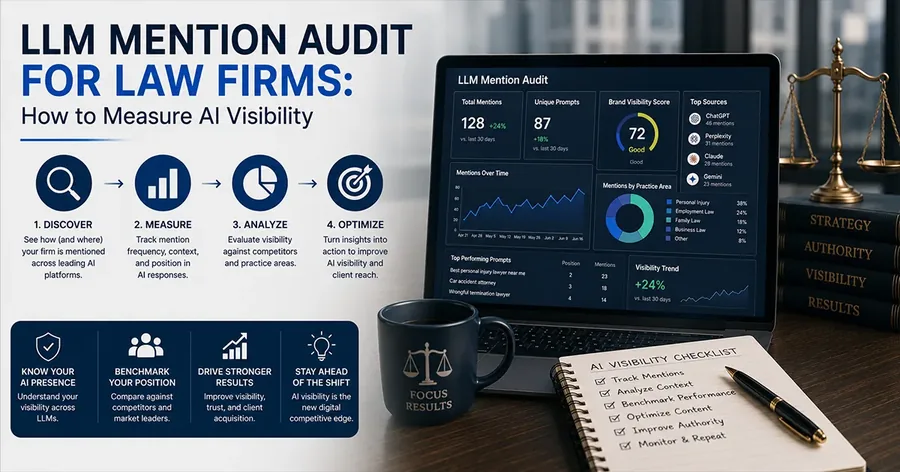
An LLM mention audit for law firms is a practical way to measure whether AI systems can find, understand, and mention your firm when prospects ask legal-service questions.
This matters because AI visibility is easy to talk about and hard to measure. A partner may see one ChatGPT answer that mentions a competitor. A marketing manager may test one prompt and see nothing. An agency may show a screenshot that looks impressive but cannot explain whether it repeats, where the answer came from, or whether it creates calls.
A useful audit brings order to that mess. It defines the prompts, systems, locations, competitors, source pages, citations, gaps, and next actions. It turns AI visibility from a vibe into a repeatable review process.
If you are still building the foundation, start with AI Visibility for Law Firms. If you want to understand the ChatGPT-specific strategy, read how to get your law firm mentioned in ChatGPT. This guide is the measurement layer: how to run the audit and decide what to fix next.
What Is an LLM Mention Audit?
An LLM mention audit is a structured review of how large language model systems respond to prompts related to your law firm, practice areas, attorneys, competitors, and local markets.
The audit looks at whether the firm is mentioned, whether competitors are mentioned, which sources are cited when citations appear, whether the answer accurately describes the firm, and which content or authority gaps may explain the results.
The goal is not to prove that one answer is permanent. AI answers can change by product, prompt wording, location, user context, retrieval source, and time. The goal is to find patterns. If your firm never appears for category prompts but competitors do, that is a signal. If your firm appears only when searched by brand name, that is a different signal. If AI systems misunderstand your practice areas, that is a fixable problem.
A good audit separates three things: brand recognition, category association, and source quality. Brand recognition asks whether AI systems know the firm exists. Category association asks whether they connect the firm to the right legal services. Source quality asks whether the public web gives them enough reliable material to support a mention.
Why Law Firms Need LLM Mention Audits
Law firms need LLM mention audits because AI-assisted discovery is becoming part of the way prospects research attorneys, compare options, and decide who to contact.
That does not mean traditional SEO is gone. Google rankings, local visibility, reviews, referrals, and paid search still matter. But AI answers add another discovery layer. A person may ask ChatGPT what to do after a crash, ask Perplexity which firms handle a certain case type, or use a Google AI feature to summarize options before clicking a result.
For a law firm, the risk is not only being absent. The risk is being misunderstood. An AI system may describe the firm too broadly, miss an important practice area, favor competitors with stronger public profiles, or cite directory pages instead of the firm's own service page.
The audit shows whether your site and surrounding web presence are creating a clear enough entity. It also helps prioritize work. The right next move might be service page improvements, attorney bio cleanup, schema fixes, external profile updates, internal linking, or new support content. Without an audit, teams tend to guess.
What an LLM Mention Audit Should Measure
A law firm LLM mention audit should measure visibility, accuracy, citation quality, competitor overlap, and conversion readiness.
Visibility is the basic question: does the firm appear at all? Accuracy asks whether the answer correctly explains the firm's practice areas, location, attorneys, and services. Citation quality looks at which sources support the answer. Competitor overlap shows which firms appear repeatedly instead of yours. Conversion readiness asks whether the cited or visited pages make it easy for a prospect to call, book, or submit an inquiry.
- Brand mention: whether the firm appears for brand, attorney, and category prompts
- Practice-area association: whether AI systems connect the firm to the right case types
- Local association: whether the firm appears for relevant market and city prompts
- Citation source: whether answers cite your website, directories, profiles, news, or competitors
- Accuracy: whether the description is correct and current
- Competitor set: which firms appear repeatedly across prompts
- Next-step quality: whether the page that could receive traffic has clear intake paths
This is why the audit should not stop at screenshots. Screenshots are evidence, not analysis. The useful output is a prioritized map of what to improve.
Step 1: Choose the AI Systems to Test
Start by choosing which AI systems matter for your firm and market.
Most law firms should test a small set first: ChatGPT, Perplexity, Google AI features where available, Gemini, and Microsoft Copilot. The point is not to test every tool on the internet. The point is to test the discovery surfaces a prospective client, referral partner, or staff member is most likely to use.
Document the product name, date, account state, location settings when available, whether search or web browsing is enabled, and whether the answer includes source links. These details matter because different modes can produce different answers.
OpenAI's crawler documentation is useful for understanding how OpenAI identifies crawler traffic, while Google's guidance for helpful, reliable content remains the baseline for building pages that deserve to be surfaced. The audit should combine both ideas: access and quality.
Step 2: Build a Prompt Set
A prompt set is the list of questions you will test across systems.
Do not use only one prompt. One prompt can be misleading. A firm may appear for its brand name but not for a category. It may appear for a broad city query but not for a specific case type. It may appear only when the prompt includes the attorney's name. The prompt set should reveal those differences.
Use four prompt groups: brand prompts, category prompts, local prompts, and comparison prompts.
- Brand prompts: What does [firm name] do? Does [firm name] handle [practice area]?
- Category prompts: Which law firms handle [practice area] in [city]?
- Local prompts: Who are [practice area] lawyers near [neighborhood or city]?
- Comparison prompts: Compare [firm name] with other [practice area] firms in [city]
- Educational prompts: What should I look for when choosing a [practice area] lawyer?
For personal injury firms, include prompts around car accidents, truck accidents, motorcycle accidents, catastrophic injury, wrongful death, premises liability, and any high-value case type the firm actually handles. For other practice areas, use the same structure with the firm's real services.
The prompt set should also include intent levels. Some prompts are informational, such as what should I do after a crash. Some are comparative, such as compare personal injury firms in a city. Some are transactional, such as find a lawyer who handles truck accident cases near me. Each intent level reveals a different part of the visibility system.
Keep the wording close to how a real prospect would ask. Do not over-engineer prompts with agency language. A person is more likely to ask for the best lawyer for a specific situation than to ask for a generative engine optimization entity recommendation. The audit should reflect real user language, not internal marketing vocabulary.
Step 3: Record Mentions, Not Just Rankings
An LLM mention audit is not a rank tracker.
AI answers may not return a clean numbered list. They may summarize options, cite sources, compare firms, ask follow-up questions, or refuse to make recommendations. The audit should record the format honestly instead of forcing it into a traditional ranking model.
For each prompt, record whether the firm appears, where it appears in the answer, whether competitors appear, whether sources are cited, which URLs are cited, whether the answer is accurate, and whether the answer includes a clear reason for the mention.
A simple scoring model can help:
- 0: firm is absent
- 1: firm appears only by brand prompt
- 2: firm appears for a category prompt but without strong detail
- 3: firm appears with accurate service or location context
- 4: firm appears with a useful source or citation
- 5: firm appears accurately, with a strong source, and the cited page has a clear conversion path
This score is not a universal industry standard. It is an internal operating tool. Its value comes from using it consistently over time.
Step 4: Control the Testing Conditions
Before you compare results, control the conditions as much as possible.
Use the same prompt set, the same account state, the same location assumptions, and the same testing window when practical. If a tool allows location context, record the location. If a tool has web search on or off, record that. If the answer cites sources, save the source URLs. If the answer changes after a follow-up question, keep the first answer separate from the conversation-expanded answer.
This discipline prevents the audit from becoming anecdotal. A partner can test a prompt from home and see one result. A staff member can test from another account and see another. That does not mean the audit is wrong. It means the process needs enough detail to explain variation.
A simple testing log should include the date, system, prompt, location, answer summary, firms mentioned, source URLs, screenshot link, score, and recommended next action. The log matters because AI visibility work is iterative. You need to know what changed between the first audit and the next one.
Step 5: Analyze Citation Sources
When an AI system cites or links to sources, those sources are often the most useful part of the audit.
A source can reveal why a competitor is being mentioned. It may be a strong service page, a legal directory, a local profile, a review platform, a news article, a bar association page, or a guide that answers the prompt better than your page does.
Separate sources into owned, earned, and third-party profile sources. Owned sources are pages on the firm's website. Earned sources are news, interviews, mentions, sponsorships, or external articles. Third-party profile sources include directories, local listings, legal profiles, and review platforms.
If AI systems cite competitor websites but not yours, your owned pages may need work. If they cite directories where competitors have stronger profiles, your external profile consistency may be weak. If they cite broad legal guides instead of local firms, the prompt may be informational rather than commercial.
Look at the source page itself, not only the domain. A directory domain may be strong, but the specific profile may be thin. A competitor page may rank because it has a clearer H1, stronger internal links, better local proof, or more complete attorney information. A news article may appear because it gives the AI system an independent source that confirms the firm handles a topic.
For each cited source, ask whether your firm has an equivalent or better source. If the answer is no, that becomes a roadmap item. Build or improve the owned page. Update the profile. Earn a relevant mention. Add internal links. Clarify the service. The audit should translate sources into action.
Step 6: Compare Competitor Patterns
Competitor patterns are usually more important than a single competitor mention.
If the same firms appear across ChatGPT, Perplexity, Gemini, and Google AI features, study why. Do they have stronger practice-area pages? More local mentions? Better attorney bios? More reviews? Better directory profiles? More pages answering the exact question? More consistent entity information across the web?
The goal is not to copy competitors. The goal is to identify the missing signal. If every competitor has a detailed attorney bio and your firm does not, that is a gap. If competitors have city-specific legal resources and your site has only generic posts, that is a gap. If competitors are cited through legal directories where your profile is incomplete, that is a gap.
Document the repeat winners. Then document the likely reason they are winning. That gives the firm a clearer roadmap than another generic content calendar.
Step 7: Check the Pages AI Systems Should Understand
After prompt testing, inspect the pages that should be supporting those prompts.
For each priority prompt, identify the best matching page on your site. If there is no matching page, that is the answer. The firm is asking AI systems to associate it with a topic the website does not explain clearly.
For each matching page, check the title, meta description, H1, headings, internal links, schema, author or firm context, service specificity, location signals, and intake path. Ask whether the page would help a human decide what to do next.
This is where the audit connects to AI-citeable content for law firms. A page that is vague, thin, or disconnected is hard to cite. A page that gives a direct answer, explains context, and links to the right service page has a better chance of supporting AI-assisted answers.
Step 8: Use GSC and Site Data as Reality Checks
The audit should not live only inside AI tools.
Google Search Console can show whether related queries are already appearing. If GSC shows impressions for AI visibility, ChatGPT visibility, LLM mention audit, or practice-area questions, that is useful demand evidence. If GSC shows no impressions for a topic, the topic may still be worth building, but the firm should understand that it is more speculative.
The Search Console performance report can be used to review queries, pages, countries, devices, clicks, impressions, CTR, and position. For AI visibility work, those signals help identify which clusters Google is already testing.
The same logic applies when deciding which content to build. The law firm ChatGPT visibility guide and this LLM mention audit belong to the same demand cluster, so publishing both lets a firm cover the broader question set those AI visibility searches represent.
What the Audit Spreadsheet Should Include
The easiest way to make the audit repeatable is to keep a structured spreadsheet.
Each row should represent one prompt tested in one system. Do not combine multiple systems into one row because that makes comparison difficult. If you test the same prompt in ChatGPT, Perplexity, Gemini, and Copilot, that should be four rows.
Useful columns include system, mode, date, location, prompt, intent type, firm mentioned, mention position, competitors mentioned, cited sources, source type, accuracy notes, conversion path quality, score, issue type, priority, owner, and recommended fix.
This may sound heavy, but the first version can be simple. The important part is consistency. A lightweight sheet with consistent scoring will produce better decisions than a beautiful report built from scattered screenshots.
The spreadsheet also helps teams avoid duplicate work. If three prompts all point to the same weak service page, the fix is probably that page. If six prompts cite the same competitor directory, the fix may be external profile work. If brand prompts are accurate but category prompts fail, the fix is probably topical association, not brand cleanup.
How to Turn Audit Findings Into Fixes
The output of an LLM mention audit should be a fix list, not a slide deck full of screenshots.
Group findings by the type of gap. Technical gaps include blocked crawlers, missing sitemap URLs, bad canonicals, broken pages, or important content that is hard to render. Content gaps include thin service pages, missing answer blocks, weak headings, or articles that do not answer the prompt. Entity gaps include inconsistent firm details, weak attorney bios, missing locations, or unclear practice-area relationships. Authority gaps include weak external profiles, few relevant mentions, or competitor citations from sources where the firm is absent.
- Technical fix: make important pages crawlable, indexable, and internally linked
- Content fix: improve the best matching page instead of publishing a duplicate article
- Entity fix: align firm, attorney, service, and location details across the site
- Authority fix: update profiles, earn relevant mentions, and strengthen citations
- Conversion fix: improve calls, forms, booking paths, and intake measurement
The strongest fix is often a page improvement, not a new page. If a practice-area page is almost right, strengthen it. If the site has no page for a prompt that matters, create one. If a new support article would cannibalize an existing commercial page, use internal links and a narrower angle instead.
For example, if the firm is absent from prompts about car accident lawyers in its city, do not immediately publish a generic blog post about car accidents. First inspect the main car accident service page. Does it explain the case type, city, attorney experience, intake path, FAQs, related injuries, and next steps? Does the page link to supporting resources? Do external profiles confirm the firm handles car accident cases? The fix should match the gap.
If the firm appears but the answer cites a directory instead of the firm's site, the issue may be source authority or page quality. Improve the owned page and make sure the directory profile links to the right destination. If the answer mentions the wrong location or outdated details, fix entity consistency across the website and major profiles.
What to Include in an LLM Mention Audit Report
A useful report should be short enough for a partner to understand and specific enough for a marketer or developer to act on.
Include the audit date, systems tested, prompt set, location assumptions, top competitors, screenshots or exports for evidence, source URLs, visibility scores, accuracy issues, and prioritized fixes.
The report should also include a baseline. Without a baseline, the firm cannot tell whether future work improved visibility. The first audit may show very little. That is fine. The baseline gives the firm something to compare against after content updates, profile cleanup, and technical fixes.
A monthly or quarterly recheck is usually enough for most firms. Weekly testing can create noise because AI answers fluctuate. The useful question is whether visibility improves over time across a consistent prompt set.
How Often Should a Law Firm Run the Audit?
Most firms should run a baseline audit, make a round of fixes, and recheck after 30 to 60 days.
That timing gives crawlers and AI systems time to discover updated pages and external profiles. It also keeps the team from reacting to every small fluctuation. AI answers can change quickly, but durable visibility usually comes from better pages, clearer entities, stronger sources, and time.
After the first recheck, a quarterly audit is enough for many small firms. Firms in competitive personal injury, criminal defense, immigration, or family law markets may want a monthly review while they are actively publishing, updating service pages, or earning new mentions.
The audit cadence should match the work cadence. If nothing changed on the site, a new audit may only confirm the same gaps. If the firm improved service pages, fixed profiles, added schema, and published stronger support content, the recheck can show whether those changes are starting to affect AI visibility.
Common Mistakes to Avoid
The first mistake is testing only branded prompts. If you ask an AI system about your exact firm name, you are mostly testing brand recognition. Prospects often ask category questions first.
The second mistake is treating a single answer as proof. One answer can be useful evidence, but it does not prove durable visibility. Test multiple systems, prompts, and dates.
The third mistake is ignoring conversion. A firm can be mentioned and still lose the lead if the cited page has no clear phone number, form, consultation path, or intake coverage.
The fourth mistake is creating fake proof. Do not claim to be recommended by ChatGPT, invent citations, fake reviews, or publish misleading screenshots. AI visibility work should raise the trust standard, not lower it.
Where VerdictIQ Fits
VerdictIQ helps law firms audit and improve AI visibility as part of a larger search-to-case system.
That includes prompt testing, GSC analysis, crawlability checks, schema review, service page structure, internal linking, AI-citeable content, external mention cleanup, and conversion paths that connect visibility to calls and consultations.
The first step is knowing where the firm stands. Run the AI Visibility Checker, review the AI visibility audit checklist, or book a strategy call with VerdictIQ if you want the audit translated into a prioritized execution plan.