

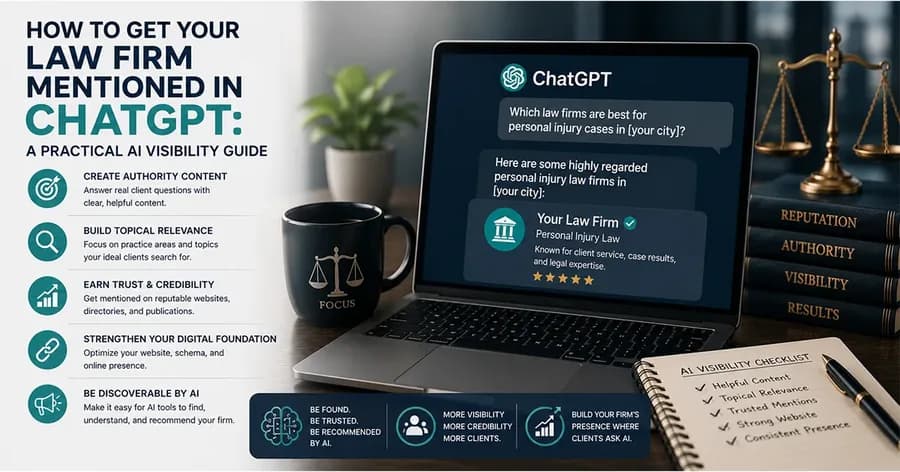
Law firm ChatGPT visibility is becoming a real marketing concern because prospects are no longer using only traditional search results to compare attorneys.
They still use Google. They still read reviews. They still ask friends and family for referrals. But many now ask AI systems questions like which lawyer handles this kind of case, what should I do after an accident, how do I compare law firms, or what makes one attorney different from another.
That does not mean a firm can force ChatGPT to recommend it. It means the firm can make its website, service pages, author signals, local footprint, and third-party mentions easier for AI-assisted search systems to understand.
This guide explains how to get your law firm mentioned in ChatGPT by improving the signals that matter: crawlable pages, clear entities, specific service content, trustworthy source material, consistent external mentions, and measurement that shows whether AI visibility is producing qualified inquiries.
If you need the broader strategy first, start with AI search visibility for law firms. If you want to diagnose the current site, use the AI visibility audit for law firms, the case visibility AI guide, or the AI Visibility Checker. This article is the practical ChatGPT mention layer.
What Does Law Firm ChatGPT Visibility Mean?
Law firm ChatGPT visibility means your firm is understandable, discoverable, and credible enough to appear in or influence AI-assisted answers when people ask legal-service questions.
A ChatGPT mention might be a direct brand mention, a cited source, a summarized page, a referral-style answer, or an explanation that includes your firm's content as part of the information path. The exact format depends on the product experience, the query, available sources, user location, and whether the system is using live search or broader model knowledge.
This is why firms should avoid thinking about AI visibility as a magic ranking list. It is closer to entity clarity plus source quality. The system has to understand who the firm is, what the firm handles, where it serves clients, why its pages are useful, and whether other reliable parts of the web support the same picture.
OpenAI's ChatGPT Search documentation explains that search can use web results and include links to sources. OpenAI's crawler documentation explains crawler access for OpenAI systems. For law firms, that makes the foundation clear: if important pages are blocked, thin, unclear, or unsupported, they are less likely to help AI-assisted discovery.
Why ChatGPT Mentions Are Different From Google Rankings
Google rankings usually show a list of pages. ChatGPT-style answers often summarize information into a response. That changes the job of the page.
A traditional SEO page tries to rank for a query and earn a click. A ChatGPT-visible page still needs SEO fundamentals, but it also needs to be easy to summarize. It should answer questions directly, define terms clearly, explain the firm's role, connect to related pages, and make the next step obvious.
This is especially important for law firms because legal questions are high trust. A vague article stuffed with keywords is not enough. AI systems and human prospects both need clarity, restraint, and evidence. The page should avoid guarantees, avoid pretending to give case-specific legal advice, and explain when a person should speak with an attorney.
The strongest firms will not treat ChatGPT visibility as a separate trick. They will improve the same foundation that helps traditional SEO, local SEO, intake conversion, and trust: service clarity, author credibility, local relevance, structured data, helpful content, and real-world proof.
Start With the Entity: Make the Firm Easy to Understand
Before ChatGPT can mention a law firm confidently, the web needs a coherent picture of the firm.
Entity clarity means your site clearly identifies the law firm name, attorneys, practice areas, locations, service area, client types, case types, intake process, credentials, and contact paths. Those details should not be scattered randomly across pages. They should be consistent in metadata, headings, body copy, schema, navigation, footer details, attorney bios, practice pages, and local profiles.
For example, a personal injury firm should not rely on one homepage sentence that says it helps accident victims. The site should have a clear personal injury service page, supporting pages for major case types, local relevance signals, attorney or team information, intake expectations, and internal links that show how those pages relate.
VerdictIQ treats entity clarity as the first layer of AI Visibility for Law Firms. If the site cannot explain itself cleanly to a person, it is unlikely to be clear to an AI-assisted search system.
Build the Pages ChatGPT Needs to Reference
A law firm cannot become visible in AI answers with only a homepage and a few generic blog posts.
The site needs source pages that answer specific questions. Those pages should include commercial pages, practice-area pages, local pages when appropriate, attorney or team pages, process pages, and supporting educational content. Each page should have a clear job.
- Homepage: explains the firm, core positioning, locations, and main services
- Practice-area pages: explain specific case types, who the firm helps, and when to contact the firm
- Location pages: explain local relevance without duplicating thin city pages
- Attorney pages: show real expertise, credentials, publications, and professional context
- Process pages: explain intake, consultation, case evaluation, and communication expectations
- Support articles: answer narrow questions that help prospects understand a problem before contacting the firm
For VerdictIQ's own site, this article supports the AI visibility service page, the audit guide, the AI-citeable content framework, and the personal injury lawyer SEO page. That relationship matters. A support article should strengthen a commercial topic cluster, not float alone.
The same principle applies to a law firm site. If the firm wants to be mentioned for truck accident, wrongful death, medical malpractice, divorce, estate planning, immigration, or criminal defense questions, it needs pages that explain those topics with enough detail to be useful. A single "practice areas" page with a list of services rarely creates enough context.
Each important service page should answer the questions a prospect would naturally ask before calling. What kinds of matters does the firm handle? What facts does the firm need during intake? What deadlines or documents may matter? What should someone avoid doing before speaking with counsel? What happens after the consultation is booked? Those answers make the page more useful to people and clearer to AI systems.
Use Answer Blocks Instead of Generic Blog Writing
ChatGPT visibility depends heavily on whether a page can answer a question clearly.
The easiest way to improve that is to use answer blocks. An answer block is a short section that answers one specific question directly, then expands with context, examples, and next steps. It is useful to a human reader and easier for AI-assisted systems to summarize.
A weak section starts with vague setup: "There are many things to consider when choosing an attorney." A stronger section answers the question immediately: "A person should compare personal injury lawyers by practice focus, local experience, communication process, review quality, case-type fit, and whether the firm has a clear intake path."
The stronger version gives the reader a useful answer before adding nuance. That is the same principle behind AI-citeable content for law firms: direct answers, specific context, clean structure, and internal links that point to the next useful page.
Make Service Pages Specific Enough to Be Mentioned
Generic service pages are hard to mention because they do not give AI systems or prospects much to work with.
A strong law firm service page should explain the service, the cases it applies to, the common client questions, the firm's process, the local or practice-area context, and the action a prospect should take. It should also link to supporting content that proves the firm understands the topic.
For personal injury firms, a page about car accidents should not only say the firm handles car accident cases. It should explain what injured people usually need help with, what information intake may collect, why medical documentation matters, how insurance communication can create confusion, and when a consultation is appropriate.
This is where many law firm websites underperform. They publish pages that sound polished but interchangeable. The city name changes, the practice area changes, but the substance does not. AI-assisted systems have little reason to treat that page as a strong source because it does not add much beyond a basic claim that the firm exists.
A stronger page has operational detail. It explains how the firm evaluates a call, which case types are a good fit, what information speeds up review, how urgent matters are routed, and what a prospect can expect next. That kind of detail does not require giving legal advice. It requires explaining the process with enough clarity that a reader can make a better decision.
The same applies to legal marketing. A page about AI visibility should not only say the firm can help with AI search. It should explain crawlability, entity clarity, answer-ready content, external mentions, schema, llms.txt, and measurement. Specificity creates source value.
Do the Technical Access Work First
If ChatGPT and search systems cannot access important pages, the content strategy is already limited.
Technical access does not need to be mysterious. Start with the basics: indexable pages, clean canonical tags, working internal links, sitemap inclusion, fast mobile rendering, accurate robots.txt rules, structured data, and a site architecture that does not bury the most important pages.
Law firms should also understand AI crawler rules. The point is not to open everything blindly. The point is to decide intentionally which public pages should be accessible and which private, admin, staging, or sensitive routes should remain blocked.
For public marketing pages, the practical checks are straightforward:
- The page returns a 200 status code
- The page has a self-referential canonical URL
- The page is included in the XML sitemap
- Important internal links point to it
- The page has a unique title, meta description, and H1
- Schema markup matches the real page type
- Robots.txt does not block public content that should be discovered
These are not glamorous tasks, but they decide whether the page can participate in discovery at all.
Add Schema, But Do Not Expect Schema to Do Everything
Schema helps machines understand page type, authorship, organization identity, breadcrumbs, articles, services, and local business details. It is useful. It is not magic.
A law firm should use truthful structured data that matches the visible page. Organization schema can define the firm. Article schema can support blog posts. Breadcrumb schema can clarify hierarchy. LocalBusiness or LegalService schema can help where the page genuinely represents a local legal business. Service schema can clarify a service page.
What the firm should not do is invent fake reviews, ratings, awards, locations, practice areas, attorney credentials, or dates. False schema is not an AI visibility strategy. It is a trust problem.
Google's helpful content guidance is still the right standard: create people-first content that demonstrates experience, expertise, authoritativeness, and trust. Schema should reinforce real content, not replace it.
Earn External Mentions That Confirm the Same Story
ChatGPT visibility is not only about what your own website says. External mentions matter because they help confirm the firm's identity and relevance.
For law firms, useful external mentions can include legal directories, bar association profiles, attorney bios, local business listings, news mentions, podcast appearances, guest commentary, case-related media when appropriate, sponsorship pages, chamber of commerce listings, local partnerships, scholarship pages, and high-quality citations from relevant organizations.
The goal is consistency, not volume for its own sake. The firm name, attorney names, office locations, practice areas, phone number, and website URL should match across important profiles. Conflicting information makes the entity harder to understand.
A useful mention strategy asks:
- Where would a reasonable person verify this law firm?
- Which profiles already rank for the firm's brand or attorneys?
- Which local or legal sites can confirm the firm's practice areas?
- Which pages mention the firm but fail to link to the website?
- Which attorney credentials or publications deserve a clear profile link?
This is also why link building and AI visibility overlap. Not every mention has to be an SEO backlink, but strong, relevant mentions help build the surrounding evidence that a firm is real, active, and associated with specific legal topics.
The cleanest external mention plan starts with accuracy. Audit the firm's major profiles and make sure the basics match: name, address, phone number, website, attorney names, practice categories, office hours, and profile descriptions. Then review whether those profiles link to the most relevant page. A generic homepage link is fine for some listings, but a practice-specific profile or article may deserve a link to a related service page.
After accuracy, look for authority. A local news article, legal association profile, attorney interview, podcast appearance, conference bio, or high-quality directory page can all help reinforce what the firm is known for. The point is not to spray the web with low-quality citations. The point is to create a consistent public record that supports the same entity story your website already tells.
Avoid the Biggest ChatGPT Visibility Mistakes
The first mistake is publishing another broad AI visibility article when the site already has one.
That creates cannibalization. If one page targets AI visibility for law firms, a new page should target a narrower sub-intent such as ChatGPT mentions, LLM mention audits, AI-citeable content, or practice-area answer blocks. Each page needs a separate job.
The second mistake is chasing prompts instead of fixing pages. A law firm cannot prompt its way around thin service pages, missing local signals, blocked crawlers, weak internal links, or inconsistent attorney profiles.
The third mistake is treating AI mentions as impossible to measure. They are harder to measure than ordinary search clicks, but the surrounding signals can still be tracked: GSC queries, referral traffic, branded search, direct traffic, source forms, call tracking notes, consultation source questions, and periodic manual AI visibility audits.
The fourth mistake is making unsupported claims. A firm should not say it is recommended by ChatGPT unless that claim is accurate, durable enough to substantiate, and presented with context. AI answers can change. Build the underlying visibility system instead of marketing a screenshot as a permanent endorsement.
Run an LLM Mention Audit
An LLM mention audit is a structured review of whether AI systems can identify and describe a law firm for relevant prompts.
The audit should not rely on one prompt, one device, or one screenshot. It should test several prompt types and record what appears, which sources are cited when citations are available, which competitors are mentioned, and which gaps repeat across systems.
Useful prompts include:
- Who are personal injury lawyers in [city]?
- Which law firms handle [practice area] in [market]?
- What should I look for when choosing a [practice area] lawyer?
- Does [firm name] handle [case type]?
- Compare [firm name] and other [practice area] firms in [city]
- What sources mention [firm name]?
Then document the gap. If the firm is absent from practice-area prompts, the service pages may be too thin or unsupported. If the firm appears for brand prompts but not category prompts, the brand exists but the category association is weak. If competitors appear with directory citations, the firm may need stronger external profiles and mentions.
This is exactly why VerdictIQ built the AI Visibility Checker: it gives firms a starting point for technical and content signals before they invest in deeper manual audits. For the full measurement workflow, use the LLM mention audit for law firms guide.
Connect ChatGPT Visibility to Intake and Revenue
A ChatGPT mention only matters commercially if it helps create qualified conversations.
That means AI visibility needs to connect to intake. If someone discovers a firm through an AI answer, visits the site, calls after hours, and nobody answers, the visibility was wasted. If the call is answered but not tracked, the firm may never know AI-assisted discovery influenced the lead.
Law firms should ask new prospects how they found the firm, track forms and calls by landing page, monitor AI/referral traffic where available, and connect consultation outcomes back to source data. The measurement will not be perfect, but it should be better than guessing.
The practical measurement stack can be simple at first. Add a required intake source question. Review GA4 referral traffic for AI and search platforms. Watch branded query growth in Google Search Console. Track which blog posts and service pages create calls or form submissions. Add notes in the CRM or case management system when a prospect says they found the firm through ChatGPT, AI search, or an AI summary.
Over time, this gives the firm a better read on whether AI visibility is creating real demand. The firm may not be able to attribute every mention perfectly, but it can still see whether branded searches are increasing, whether AI-related pages are earning impressions, whether consultation sources are changing, and whether the visibility cluster is helping the pipeline.
This is where AI visibility connects to revenue infrastructure and GateKeeperAI. Visibility creates demand. Intake captures it. Tracking explains whether it turned into booked consultations and signed clients.
A Practical 30-Day Plan
A law firm can start improving ChatGPT visibility in 30 days without turning the entire site upside down.
Week one should focus on discovery. Run an AI visibility audit, inspect GSC queries, review indexed pages, check robots.txt, check sitemap coverage, and identify which AI or ChatGPT-related queries are already appearing.
Week two should focus on entity clarity. Update the homepage, practice pages, attorney profiles, schema, footer details, and internal links so the firm's core services, locations, attorneys, and contact paths are consistent.
Week three should focus on source pages. Improve one commercial service page and one support article. Add direct-answer sections, clearer headings, stronger internal links, and truthful external citations where source-backed claims are made.
Week four should focus on mentions and measurement. Audit external profiles, fix inconsistent listings, identify unlinked mentions, add source questions to intake, and set a schedule for monthly LLM mention checks.
This sequence works because it starts with the foundation before chasing visibility. The firm becomes easier to crawl, easier to understand, easier to cite, and easier to measure.
What to Write Next After This Page
After a ChatGPT visibility guide, the next support content should target narrower questions inside the same cluster.
Good follow-up topics include LLM mention audits for law firms, how to structure attorney bio pages for AI search, how to make personal injury content citeable by AI, how to measure ChatGPT referral traffic, and how AI visibility connects to local SEO.
The key is to keep every article distinct. One page owns the broad AI visibility topic. One page owns the audit checklist. One page owns citeable content. This page owns ChatGPT mentions. That structure prevents cannibalization and gives crawlers a cleaner topic map.
Where VerdictIQ Fits
VerdictIQ helps law firms build the system behind AI visibility.
That includes crawlability, schema, llms.txt review, service page structure, ChatGPT and LLM mention audits, internal linking, content architecture, tracking, and intake paths that make new visibility measurable.
If your firm wants to know whether ChatGPT can understand, mention, and route prospects toward your website, start with AI Visibility for Law Firms. Then use the AI Visibility Checker or book a strategy call with VerdictIQ to map the next fixes.
Frequently Asked Questions
How can a law firm improve ChatGPT visibility?
A law firm can improve ChatGPT visibility by making key pages crawlable, clarifying entities, publishing specific answer-ready content, earning consistent external mentions, and measuring whether AI discovery turns into qualified inquiries.
Is ChatGPT visibility the same as SEO?
No. SEO helps pages rank and earn clicks in search results. ChatGPT visibility depends on many of the same foundations, but it also requires content that AI systems can understand, summarize, cite, and connect to a clear law firm entity.
Can a law firm guarantee ChatGPT mentions?
No law firm or vendor can guarantee durable ChatGPT mentions because AI answers change by query, source access, model behavior, location, and available evidence. The practical goal is to improve the signals that make mentions more likely and measurable.