

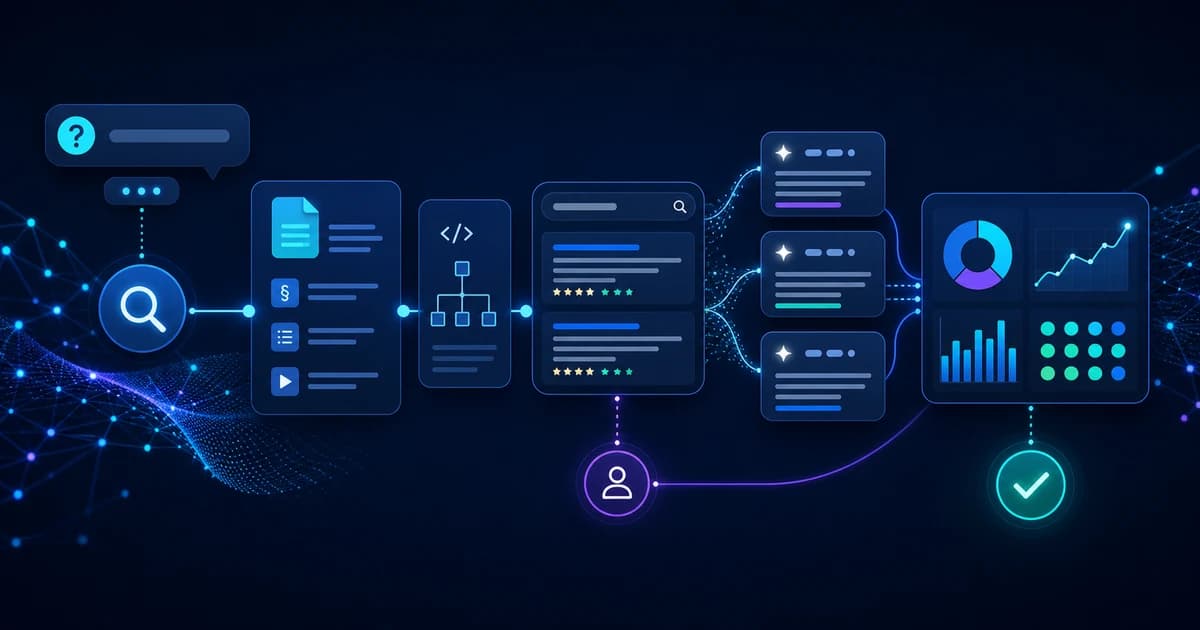
Case visibility AI for law firms is becoming a practical search problem, not just a technology trend.
Prospective clients are no longer only typing short keywords into Google. They ask longer questions in Google, ChatGPT, Gemini, Perplexity, Copilot, and other answer systems. They describe what happened, ask what kind of lawyer they may need, compare options, and look for next steps before they ever call a firm.
That changes the visibility challenge. A law firm does not only need to rank for a practice-area keyword. It needs to be findable and understandable when a prospect asks a case-specific question.
This article explains what case visibility means in AI search, how it differs from ordinary rankings, why it matters for law firms, and how to build a content and measurement system that connects AI visibility to calls, consultations, and signed clients.
If you need the broader foundation first, read AI search visibility for law firms. If you want the diagnostic checklist, use the AI visibility audit for law firms. This guide is narrower: how to improve visibility around the case questions prospects actually ask.
What Is Case Visibility AI for Law Firms?
Case visibility AI for law firms is the ability of a firm, practice area, attorney, or page to appear, be cited, or be understood when a person asks an AI-assisted search system a question about a legal situation.
The phrase can sound vague because case visibility also appears in software conversations about client portals and case status tracking. That is a different problem. This article is about search visibility: whether a firm is discoverable when a prospect asks about a potential case.
A case visibility prompt might look like this:
- Do I need a lawyer after a rear-end accident?
- What should I do after a slip and fall at a store?
- Who handles wrongful death cases near me?
- Can I sue if a drunk driver hit me?
- What questions should I ask a personal injury lawyer?
- Which law firms handle car accident cases in my city?
- How do I know if a personal injury firm is credible?
Traditional SEO might target one keyword from that list. AI visibility has to support the whole question set. The firm needs pages that explain the case type, location, process, evidence, intake path, attorney credibility, and next step clearly enough for both people and machines to understand.
Why Case Visibility Is Different From Ranking Visibility
Ranking visibility asks whether a page appears in search results for a keyword.
Case visibility asks whether the firm is a credible answer source for the situation behind the query. That is a broader standard. A page may rank for personal injury lawyer but fail to answer the specific questions a prospect asks after a car accident, slip and fall, dog bite, medical injury, or wrongful death.
AI systems often summarize, compare, and synthesize. They may draw from pages that explain concepts directly, show clear topical relationships, and make entities easy to identify. They may also rely on sources outside the firm's website, including local profiles, directories, reviews, citations, and other third-party mentions.
That does not make traditional SEO obsolete. It makes the fundamentals more important. Google's helpful content guidance still points toward content that is useful for people first. Google's SEO Starter Guide still reinforces crawlability, clear page structure, links, and useful content. Case visibility builds on those foundations.
The Case Visibility Stack
Law firms should think about case visibility as a stack, not as one blog post.
The stack has five layers:
- Technical access: search engines and AI crawlers can discover, render, and index the important pages
- Entity clarity: the site clearly identifies the firm, attorneys, services, practice areas, locations, and proof points
- Case-specific content: pages answer the real questions prospects ask about their situations
- External confirmation: third-party profiles, citations, reviews, and mentions reinforce what the site says
- Conversion and tracking: calls, forms, consultations, and signed cases are measured after visibility creates demand
Most firms are weak in at least one layer. Some have useful content but poor technical access. Some have good service pages but weak external confirmation. Some get visibility but lose leads in intake. Some track rankings but cannot connect visibility to signed clients.
The best case visibility work improves the full stack instead of treating AI search as a separate trick.
Start With the Case Types That Matter Most
A law firm should not try to become visible for every legal question at once.
Start with the case types that matter most to the business. For a personal injury firm, that may include car accidents, truck accidents, motorcycle accidents, pedestrian accidents, slip and fall injuries, dog bites, wrongful death, medical malpractice, and catastrophic injuries. For another firm, the priority list may be divorce, custody, DUI, immigration, probate, employment, or business disputes.
Each case type needs a page or cluster that explains what the situation is, who the page is for, what facts matter, what mistakes to avoid, what evidence helps, what the process may look like, and when to contact the firm.
For personal injury SEO, the broad topic is covered in the personal injury lawyer SEO guide. The case-specific version is covered by resources like the car accident lawyer SEO guide. Case visibility work connects those pages into a clearer AI-search surface.
Build Pages Around Questions, Not Just Keywords
Keywords still matter, but AI-assisted search rewards pages that answer questions clearly.
A keyword page might target car accident lawyer. A case visibility page or section should also answer the questions behind that keyword: what to do after the crash, what evidence to gather, whether medical treatment matters, how insurance affects the claim, what happens if the other driver is uninsured, and when the firm should be contacted.
The page should use direct-answer sections, descriptive headings, short definitions, FAQ blocks, internal links, and clear next steps. It should avoid vague marketing copy that says the firm fights for clients without explaining the actual situation.
The goal is not to stuff every possible phrase onto one page. The goal is to make the page useful enough that a person and an AI system can understand what the firm handles, where it handles it, and why the page is relevant to the case described.
Make the Firm's Entities Easy to Understand
AI systems need context. They need to understand the firm as an entity, not just a set of isolated pages.
That means the site should make the basics clear: firm name, attorneys, practice areas, locations, service area, case types, phone number, address where appropriate, credibility signals, and relationships between pages.
Schema can help when it is accurate. Breadcrumbs, Article schema, Organization schema, LocalBusiness or LegalService schema where appropriate, and FAQPage schema can all support clarity. Schema should not invent reviews, ratings, awards, or claims the firm cannot support.
Entity clarity also depends on consistency outside the website. Google Business Profile, legal directories, social profiles, attorney bios, local citations, and review platforms should not contradict the website. Google's local ranking documentation explains relevance, distance, and prominence for local results. Those same clarity signals help the broader visibility system.
Create Case-Specific Answer Blocks
Answer blocks are short, self-contained sections that directly answer a question a prospect might ask.
For example, a personal injury page might include sections like:
- What should I do after a car accident?
- When should I call a personal injury lawyer?
- What evidence should I save after a slip and fall?
- What if the insurance company calls me?
- What happens during a free consultation?
- What information does the firm need during intake?
Each answer should be specific enough to be useful but careful enough to avoid legal advice that depends on facts not yet reviewed. Intake pages should collect information and explain next steps. Attorney review should handle legal judgment.
This is where case visibility connects to law firm intake automation. If a prospect asks a case question, finds the firm, and calls, the intake path must capture the opportunity safely and consistently.
Use Internal Links to Show Topic Relationships
Internal links help both users and crawlers understand which pages belong together.
A case visibility cluster should connect the main service page, case-type pages, local SEO content, AI visibility content, intake content, and measurement content. The anchor text should describe the destination. Read more is weak. AI visibility audit for law firms or law firm intake automation is better.
For the VerdictIQ AI visibility cluster, the relationships are clear: the AI Visibility for Law Firms service page explains the offer, the AI visibility audit explains diagnosis, the law firm ChatGPT visibility guide explains one platform, and the LLM mention audit explains measurement.
Measure Case Visibility in GSC and Beyond
Case visibility should be measured with more than a manual prompt test.
Google Search Console can show whether case-specific queries are starting to produce impressions, clicks, CTR, and position. The Search Console performance report is useful because it shows the actual queries Google is testing against pages.
But GSC is only one layer. Law firms should also track AI prompt mentions, cited sources, referral traffic, organic landing pages, calls, forms, booked consultations, qualified leads, and signed clients. A page that appears in AI search but does not create a measurable intake path is not finished.
A basic case visibility dashboard should include:
- Case-specific GSC queries and pages
- AI system mentions by prompt type
- Sources cited by AI systems
- Organic and referral traffic by landing page
- Calls and forms from case-type pages
- Booked consultations by source
- Signed clients by practice area
- Pages that receive impressions but no clicks
That last category matters. If a page gets impressions but no clicks, the title and description may need work, the position may be too low, or the page may not match the searcher's intent. The fix should depend on the data.
Do Not Ignore Intake Coverage
Visibility only creates value when the firm captures the lead.
A prospect who finds the firm through Google, ChatGPT, Perplexity, or a local result may be ready to call immediately. If the firm misses the call, delays follow-up, or fails to qualify the lead, the visibility work leaks out of the system.
That is why case visibility should connect to intake. A strong system answers quickly, asks the right practice-area questions, avoids legal advice, books the next step when appropriate, and records source data so the firm can understand which visibility channels are working.
For personal injury firms that need call coverage, GateKeeperAI is built around that handoff: answer, qualify, gather facts, book, and report without turning intake into legal advice.
Common Case Visibility Mistakes
The first mistake is publishing broad articles without supporting case-type pages. A general post about personal injury may not help a prospect asking about a specific accident scenario.
The second mistake is creating AI visibility content that is disconnected from service pages. If the AI article does not link to the practice-area page, intake page, or consultation path, it may create awareness without conversion.
The third mistake is relying only on prompts. Manual ChatGPT or Perplexity tests are useful, but they are not enough. The firm needs GSC, analytics, call tracking, and intake outcomes.
The fourth mistake is making unsupported claims. Do not say the firm is recommended by AI, cited by AI, or the top answer unless the firm can prove it and the claim is not misleading. Case visibility should raise the trust standard, not lower it.
How to Prioritize Case Visibility Pages
Most firms do not need dozens of new pages at once. They need the right pages improved in the right order.
Start with business value. Which case types produce the matters the firm wants most? Which practice areas justify more content, stronger local pages, better attorney proof, and tighter intake coverage? If a case type is low value or outside the firm's current focus, it should not lead the content plan simply because the keyword looks interesting.
Then review existing visibility. Search Console can show whether Google is already testing a page for related queries. A page with impressions but no clicks may need a better title, meta description, section structure, or stronger answer blocks. A page with no impressions may need more internal links, clearer intent, or a different topic angle.
Next, check conversion readiness. If the page already gets traffic but has weak calls to action, no phone tracking, no form tracking, or no clear intake path, the priority may be conversion rather than another article. Visibility without intake coverage can make the firm busier without making the pipeline healthier.
Finally, check whether the case type has enough supporting proof. A strong case visibility page should connect to attorney bios, location information, related case-type pages, FAQs, reviews or testimonials where allowed, and external profiles that confirm the firm actually handles that work.
How Often Should Law Firms Refresh Case Visibility Content?
Case visibility content should not be treated as a one-time publish task.
A practical cadence is monthly review for the highest-value pages and quarterly review for supporting pages. Monthly review does not mean rewriting everything. It means checking whether the page is getting impressions, whether the queries match the page intent, whether competitors have added stronger answers, whether internal links are still current, and whether the intake path still works.
Refreshes should be specific. Add a missing answer block. Improve a heading. Clarify the case type. Add a link to a newer support article. Update a stale CTA. Strengthen the schema if the page structure changed. Add a source where a claim needs support. Remove vague paragraphs that do not help a prospect make a decision.
Do not refresh only for the sake of changing the date. Search engines and AI systems need better information, not decorative edits. A meaningful update should make the page clearer, more complete, more useful, or easier to connect to the rest of the firm's visibility system.
What to Do When a Case Visibility Page Gets Impressions But No Clicks
No-click impressions are useful diagnostic data.
If the page ranks low, the first fix is usually depth and authority. The page may need better content, more internal links, stronger related pages, clearer local relevance, or external confirmation. If the page ranks closer to page one but still gets no clicks, the title and meta description may not match the query well enough.
Look at the exact queries. If the page is getting impressions for questions it does not answer, add a section that answers them or link to the better matching page. If the page is getting impressions for a topic that deserves its own page, create the page only after confirming it will not cannibalize an existing service page.
For AI visibility, no-click impressions may still have value because AI summaries and answer engines can change how users behave. But the firm should not assume value without measurement. Track whether branded search, direct traffic, referral traffic, calls, and consultation volume change after the visibility work.
A Practical Case Visibility Checklist
Use this checklist before publishing another AI visibility article:
- The main service page clearly explains the practice area and next step
- Case-type pages exist for the matters the firm wants most
- Each case page answers specific prospect questions
- Attorney, location, and firm entities are clear and consistent
- Schema is truthful and matches the page content
- Internal links connect service, case, local, AI, and intake pages
- Google Business Profile and major profiles reinforce the same services
- Calls and forms preserve landing-page and source data
- AI prompt tests are logged with dates, systems, prompts, and cited sources
- GSC impressions and no-click pages are reviewed monthly
If the firm cannot check most of these boxes, more content may not be the first fix. The existing pages may need structure, links, schema, or intake tracking before another post can help.
Where VerdictIQ Fits
VerdictIQ treats case visibility as part of a full search-to-case system.
That system includes technical SEO, AI visibility, content structure, entity clarity, internal links, Google Search Console analysis, prompt testing, call tracking, intake automation, and reporting that connects visibility to qualified consultations and signed cases.
The goal is not just to appear in more AI answers. The goal is to become a clearer, more trusted, more measurable option when a prospect asks a case-specific question and then decides who to contact.
If you want to see where your firm is visible now, start with the AI Visibility Checker. If you want the full roadmap, book a VerdictIQ strategy call and we will map your case visibility, content, tracking, and intake gaps.
Final Thought
Case visibility AI for law firms is not about chasing a new acronym.
It is about making the firm easier to discover when prospects describe real legal situations. That requires clear pages, useful answers, connected entities, external confirmation, and an intake path that can turn visibility into a qualified conversation.
The firms that benefit from AI search will not be the firms that publish the most generic AI content. They will be the firms that explain their case types clearly, prove their relevance, measure their visibility, and capture the lead when the prospect is ready to act.