

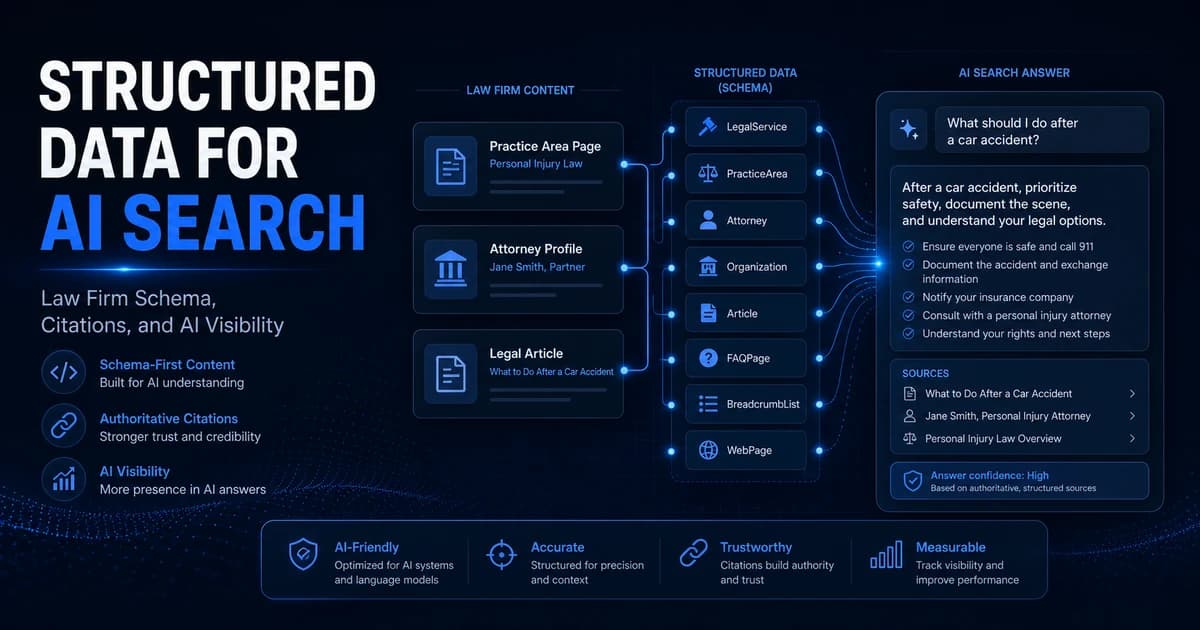
Structured data for AI search is becoming more important for law firms because AI-assisted discovery depends on clear entity signals. Search engines and AI systems need to understand the firm, the attorneys, the practice areas, the service locations, the article topics, and the relationship between pages. Schema markup does not replace good content, but it can make a strong page easier to interpret.
The AI visibility cluster for law firms is expanding: AI visibility for law firms, legal search visibility, AI visibility audits, and structured data for AI search law firm. Alongside the broad guides, there is a clear need for a focused support article that explains the markup layer specifically.
This guide is not another broad AI search visibility for law firms overview. It is the technical and content-architecture layer: what law firms should mark up, what schema can and cannot do, how internal links support AI understanding, and how to avoid turning structured data into fake authority.
What Structured Data Does for AI Search
Structured data is machine-readable markup that helps search systems understand the meaning of a page. The most common format for SEO is JSON-LD schema. It can identify an organization, article, attorney profile, service page, breadcrumb path, website, or local business entity. Google's structured data documentation explains that structured data helps Google understand page content and can make pages eligible for certain search features when the content qualifies.
AI search adds another reason to care about structure. Large language models and AI answer systems look for clear, repeated, consistent signals. They evaluate the words on the page, the surrounding site architecture, citations, external mentions, and machine-readable metadata. If the page says one thing, the title says another, the internal links point somewhere else, and the schema is generic, the firm is harder to understand.
Structured data is not a secret ranking button. It does not make thin content useful. It does not prove expertise on its own. It does not create a legitimate attorney profile out of a weak page. The value is clarity. Schema helps reduce ambiguity when the page is already accurate, specific, and connected to the right site structure.
Why Law Firms Need Entity Clarity
A law firm site is full of entities. The firm is an organization. Each attorney is a person. Each practice area is a service. Each office or service area may be tied to a local business context. Each blog post is an article. Each FAQ-style answer is part of a larger topic. Each case type has a relationship to injuries, legal process, deadlines, insurance, consultation, and attorney review.
When those entities are clear, search systems can build a better picture of the firm. They can see that the personal injury page, car accident page, local SEO page, intake page, and AI visibility content are not random posts. They are connected to a legal technology company that helps law firms turn search, intake, and AI visibility into qualified consultations.
When those entities are messy, AI systems may struggle. A page can rank for the wrong intent, miss important context, or fail to become a reliable citation source. This is why VerdictIQ treats structured data as part of the same system as content depth, internal linking, page titles, author information, and conversion paths.
Schema Types Law Firms Should Understand
A law firm does not need every schema type. It needs a small set of accurate schema types that match real page content. The most useful starting point is usually Organization, WebSite, WebPage, Article, BreadcrumbList, Person, LegalService, and in some cases LocalBusiness. Schema.org's LegalService type can describe legal services, but it should be used carefully and truthfully.
| Schema Type | Best Use | Law Firm Example |
|---|---|---|
| Organization | Identify the firm or company behind the site | VerdictIQ as the publisher and service provider |
| WebSite | Describe the site and its search context | The main verdictiq.org website entity |
| WebPage | Identify a specific page and its topic | AI visibility service page or intake service page |
| Article | Mark up blog posts and editorial content | A law firm SEO pricing article with author and dates |
| BreadcrumbList | Clarify page hierarchy | Home to Blog to Article |
| Person | Identify attorneys or authors | Attorney profile or author byline |
| LegalService | Describe legal service offerings when the firm provides them | Practice-area service pages for a law firm |
| LocalBusiness | Support real local office details | Office page with verified address, phone, and service area |
What AI Systems Need Beyond Schema
AI systems do not rely on schema alone. They need content that answers a question cleanly. They need consistent naming. They need pages that cite real sources when factual claims require support. They need internal links that show which pages are pillars and which pages are supporting explanations. They need evidence that the firm is a real entity with real services, real people, and a clear point of view.
For example, if a law firm wants to be visible when someone asks about car accident deadlines, the page should not only contain a title and schema. It should answer the question, explain the jurisdiction limits, avoid unsupported claims, link to the right practice page, identify the reviewer or author, and keep the language precise enough for a reader to trust.
That is the same idea behind the AI-citeable content framework. Structured data supports that framework, but it cannot replace the answer block, the source trail, or the editorial judgment.
How to Mark Up Law Firm Service Pages
Service pages are usually the most important structured data opportunity because they connect the firm to commercial intent. A personal injury lawyer SEO page, AI visibility page, or intake automation page should make it clear what the service is, who it is for, what problem it solves, and how it connects to the rest of the site.
The page title, H1, meta description, body copy, internal links, and schema should all agree. If the H1 says AI visibility for law firms, the page should not drift into a generic technology pitch. If the schema identifies the page as a service, the content should describe a real service, not a loose topic. If the page is for law firms, the examples should be legal and operational, not generic SaaS examples.
- Use one clear service topic per page
- Tie the page to the correct organization or local entity
- Include a self-referential canonical URL
- Use descriptive internal links to related services and supporting articles
- Avoid fake ratings, fake reviews, fake awards, or unsupported claims
- Keep the visible content and schema consistent
- Update modified dates only when the page meaningfully changes
How to Mark Up Blog Posts for AI Visibility
Blog posts should usually use Article or BlogPosting schema with a headline, description, image, author, publisher, date published, date modified, canonical URL, and main entity of page. This gives search systems a clean editorial record. It also helps AI systems understand that the post is a specific authored resource, not a loose page fragment.
The visible article still matters more than the markup. A post about law firm intake automation should answer intake automation questions. A post about SEO cost should explain the work, not only repeat pricing phrases. A post about AI audit trails should document governance and review steps, not compete with the broad AI visibility service page.
This is why every VerdictIQ blog post gets a topic-specific image, title, description, author byline, canonical URL, internal links, article schema, and a place inside a cluster. The structure is consistent because AI visibility depends on clarity at the site level, not only one clever page.
Structured Data Mistakes Law Firms Should Avoid
The most common mistake is adding schema that the visible page does not support. A firm may want to mark up every page as a service page, every answer as an FAQ, or every attorney mention as a full profile. That can create noise. Markup should clarify what is already true on the page.
The second mistake is using outdated or irrelevant schema because a plugin offers it. For example, FAQ markup should not be treated as a guaranteed Google rich result strategy for commercial sites. It may still help organize content for readers and AI systems, but it should not be added only because someone expects a search enhancement.
The third mistake is leaving schema disconnected from internal links. A page can have technically valid markup and still be weak if no important page links to it, no supporting post reinforces it, and the site architecture does not show why the page matters.
A Practical Structured Data Checklist
Law firms can start with a straightforward checklist. The goal is not to mark up everything. The goal is to make important pages easy to understand, easy to verify, and easy to connect to related content.
- Confirm the homepage has truthful Organization schema
- Confirm service pages have unique titles, descriptions, canonicals, and clear topic focus
- Use Article schema for blog posts with author, dates, image, and publisher
- Use BreadcrumbList schema to clarify page hierarchy
- Use Person schema only when there is a real attorney or author profile to support it
- Use LegalService or LocalBusiness schema only when the visible content and firm details justify it
- Keep schema dates aligned with visible publication and update dates
- Validate schema before publishing major pages
- Review internal links so each important page receives support from at least two relevant pages
Google's Rich Results Test can help confirm whether structured data is readable. Schema.org's validator can help inspect broader schema markup. Passing a validator is not the same as ranking, but failing basic validation is a signal to fix the implementation.
How Structured Data Fits Into a Law Firm AI Visibility Strategy
Structured data should sit beneath the broader AI visibility strategy. The service page explains the offer. The pillar article explains the main concept. Supporting posts answer narrow questions. Internal links connect those pieces. Schema clarifies the entities and page types. GSC shows whether Google is testing the content. AI prompt tests show whether language models understand and cite the firm.
That system is stronger than publishing isolated posts and hoping AI tools notice. A law firm that wants visibility in AI answers needs a recognizable entity, clear service pages, helpful articles, reliable citation paths, and a site structure that makes the relationship between those assets obvious.
The AI visibility for law firms page explains how VerdictIQ turns that into a service. The AI visibility audit explains how to diagnose gaps before publishing more content.
What to Measure After Adding Structured Data
After adding structured data, law firms should measure whether the page becomes easier to discover and easier to interpret. GSC can show impressions, queries, pages, click-through rate, and average position. It will not prove that a language model cited the page, but it can show whether the page is entering the search results for the intended topic.
For AI visibility, the firm should also test prompts over time. Ask the kinds of questions prospects ask. Record whether the firm is mentioned, which sources are cited, whether the answer reflects the page accurately, and whether any missing context should be added. That process belongs inside an AI audit trail, because visibility claims should be documented rather than guessed.
How to Prioritize Structured Data Work
Most law firms should not start by trying to mark up every page. Start with the pages that carry the most strategic weight. That usually means the homepage, core service pages, major practice-area pages, high-value local pages, attorney profile pages, and the blog posts that support those pages. If a page is not important enough to link to, refresh, or measure, it probably should not be the first schema priority.
The homepage should establish the organization clearly. Service pages should establish the offer clearly. Attorney pages should identify real people and the content that supports them. Blog posts should reinforce specific questions and should point back to the right commercial page. Breadcrumbs should make the site hierarchy readable. This sequencing creates a cleaner entity graph than a sitewide markup plugin that treats every page the same.
Prioritization also helps avoid accidental cannibalization. If three pages all claim to be the primary page for AI visibility, the site sends a mixed signal. One page should own the main service intent. Supporting posts should answer narrower questions and link back to the pillar. Schema should reflect that relationship instead of pretending every article is the main offer.
| Priority | Page Type | Structured Data Focus |
|---|---|---|
| 1 | Homepage | Organization, WebSite, core brand entity, sameAs where truthful |
| 2 | Service and practice pages | WebPage, service intent, internal links, canonical URL |
| 3 | Attorney and author pages | Person details supported by visible credentials and byline context |
| 4 | Blog posts | Article, author, publisher, dates, image, main entity of page |
| 5 | Supporting local pages | LocalBusiness or LegalService only when real office and service details support it |
How Internal Links Reinforce Schema Signals
Internal links are the visible version of the same structure schema is trying to clarify. If the schema says a page is an important article about structured data for law firms, the site should support that claim with links from related AI visibility pages, schema discussions, and content architecture posts. If no relevant page links to it, the article may look isolated.
Use descriptive anchor text. A link that says structured data for AI search tells readers and crawlers more than a vague link that says read more. This is especially important inside a topic cluster. The anchor should make the relationship between pages obvious without stuffing keywords or forcing awkward phrases.
For law firms, internal links should usually move in two directions. Pillar pages should link down to useful supporting posts, and support posts should link back up to the commercial or strategic page. This helps users keep moving and helps search systems understand which page should be treated as the main destination for the broader intent.
What Structured Data Cannot Fix
Structured data cannot fix a thin page, a slow site, a confusing service offer, a missing author, a weak intake path, or unsupported claims. It can make a good page clearer, but it cannot make an unhelpful page authoritative. If a firm has a shallow practice-area page with no clear answers, no source trail, no attorney context, and no useful next step, schema will not turn that page into a trustworthy AI citation.
It also cannot replace external credibility. AI systems look beyond one page. They may consider whether the firm is mentioned consistently elsewhere, whether the brand appears in relevant contexts, whether the site structure is coherent, and whether the content aligns with known facts. Schema is one layer in that stack, not the whole stack.
The best way to use structured data is to pair it with visible quality. Make the page useful first. Add schema to clarify what the page already proves. Then measure whether the page receives more relevant impressions, cleaner query matching, and better AI visibility signals over time.
For a law firm, that means schema work should usually be reviewed alongside content strategy, not handed off as a one-time technical task. The person improving markup should understand which page owns the main service intent, which posts are support assets, which attorney or office details are visible on the site, and which claims need stronger sourcing before they are reinforced through structured data.
That review keeps the markup honest, useful, and aligned with the way prospects actually search.
Final Takeaway
Structured data for AI search helps law firms make their content easier for machines to understand, but it only works when the visible page is already useful. The winning formula is clear content, accurate schema, consistent entity signals, strong internal links, real authorship, and honest measurement.
If your firm wants to improve AI visibility without creating duplicate content or fake markup, book a VerdictIQ strategy call. We will help map the schema, internal links, content gaps, and AI visibility tests that actually support discoverability.
Frequently Asked Questions
Does structured data help law firms rank in AI search?
Structured data can help AI and search systems understand a law firm page, but it does not replace useful content, authority, internal links, or accurate sourcing.
What schema should a law firm use first?
Most firms should start with Organization, WebSite, WebPage, Article, BreadcrumbList, Person where supported, and LegalService or LocalBusiness only when the visible content justifies it.
Can law firms add schema without changing the page content?
They can, but schema should match visible page content. If the page is vague, unsupported, or off-topic, markup will not fix the underlying content problem.