

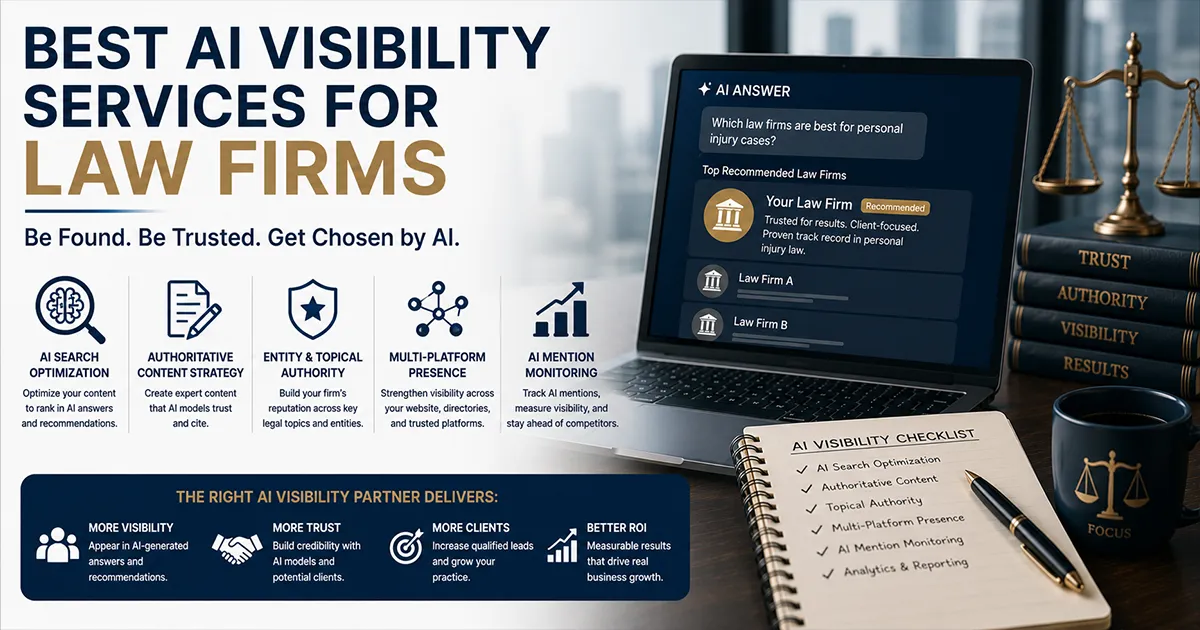
The best AI visibility service for a law firm in 2026 is the one that gets your firm named inside the AI answers your clients actually read, and then proves those answers turned into signed cases. Everything else is a feature list. Prospective clients increasingly ask ChatGPT, Google AI Overviews, Perplexity, and Gemini for a lawyer before they ever open a list of blue links, and if the model does not mention your firm, you are invisible at the exact moment of intent.
That shift is why a new category, generative engine optimization or GEO, has grown up next to traditional law firm SEO. SEO ranks your page in a list. GEO works to make your firm the recommended answer inside an AI response. This guide compares the strongest AI visibility and GEO services for law firms honestly, names what each one is genuinely best at, and helps you match the service to your firm rather than the other way around.
VerdictIQ is one of the options below, and we built it for a specific firm: the small to mid sized practice that wants to be cited by AI and wants to measure whether that visibility produces real revenue. We will say plainly where other providers fit better, because a comparison that pretends one agency wins every category helps no one deciding where to spend marketing budget. You can pressure test your own firm first with our free AI visibility checker.
What AI Visibility and GEO Actually Mean for Law Firms
AI visibility is whether AI answer engines mention, cite, or recommend your firm when someone asks a legal question in your practice area and market. GEO is the work that earns that: structured content, clear entity signals, authoritative sourcing, and answer blocks that a model can lift directly into its response. It overlaps with SEO, because the same authority and content quality help both, but the goal is different. SEO wants a ranking. GEO wants the citation.
This matters because client behavior has already moved. Industry reporting in 2026 indicates a meaningful share of consumers now use ChatGPT to research lawyers, and AI Overviews appear on a large portion of legal queries, especially the longer, question style searches that signal real intent. The American Bar Association has covered how AI powered search is reshaping how clients find counsel. For the practitioner level version, our guide on AI search visibility for law firms walks through how attorneys actually show up in AI answers.
The catch that most firms miss: visibility is only half the job. If you cannot tell which signed cases came from an AI mention, you cannot justify the spend or scale what works. That measurement gap is why we treat AI visibility and revenue attribution as one problem, not two.
How We Compared These Services
We scored every provider on the same questions. How central is AI visibility and GEO to what they do, versus a feature bolted onto traditional SEO? What kind of firm are they built for, solo and small, mid sized, or elite and enterprise? How transparent is pricing? And critically, do they help you measure whether AI visibility turns into signed cases? The descriptions below reflect each provider's current public positioning as of May 2026. Where a provider does not publish pricing, we say so rather than guess.
AI Visibility Services for Law Firms Compared
Use this matrix to narrow the field, then read the breakdowns underneath for the nuance a table cannot capture. Find the row that matters most to your firm, usually best fit or measurement, and eliminate from there.
| Provider | AI / GEO focus | Best for | Pricing | Free AI check |
|---|---|---|---|---|
| VerdictIQ | AI-visibility-first + revenue attribution | Small to mid firms wanting measurable AI visibility | Custom, free check to start | ✓ AI visibility checker |
| Rankings.io | AI optimization added to elite SEO | Elite personal injury firms | Premium, quote based | Consultation |
| Juris Digital | AI search optimization within SEO | Firms wanting a limited-roster SEO partner | Approx $2k to $5k+/mo | Consultation |
| Scorpion | AI features in full-service marketing | Large firms wanting all-in-one | Enterprise, quote based | Consultation |
| MileMark Media | AEO and GEO plus local citations | Firms bridging local SEO and AI | Quote based | Consultation |
| Esquire Digital | Citation-worthy content, Information Gain | Content-heavy GEO programs | Quote based | Consultation |
| BigDog ICT | AIO, GEO, AEO, and PPC | Firms wanting AI-visibility specialists | Quote based | Consultation |
| FirmPilot | AI-driven marketing automation | Firms wanting AI-automated execution | Quote based | Consultation |
The 8 Best AI Visibility Services for Law Firms in 2026
1. VerdictIQ, Best for Measurable AI Visibility at Small and Mid Firms
VerdictIQ is built for the firm that wants to be cited by AI and wants proof it is working. The approach is AI-visibility-first: GEO content structured into citable answer blocks, entity and authority signals, and a free AI visibility checker so a firm can see where it stands before committing to anything. What sets it apart is the revenue layer. VerdictIQ pairs visibility with tracking infrastructure so a firm can see whether AI driven discovery actually becomes signed cases, instead of trusting a vanity report.
The honest tradeoff: VerdictIQ is not an elite, enterprise only shop with a decade of personal injury case studies, and it is not the right pick for a national firm that wants a hundred person agency. Where it stands out is focus and measurement for small and mid sized firms that cannot afford to spend blind. See the full approach on the AI visibility page, or the broader services overview, and start with the free check.
2. Rankings.io, Best for Elite Personal Injury Firms
Rankings.io has served attorneys since 2013 and narrowed to personal injury firms, where it has built a strong track record and well known case studies. Its model layers AI optimization onto an established, aggressive SEO engine, with technical SEO, content, and local services ads. For a high budget PI firm competing in a crowded market, that depth and specialization is the draw.
The considerations are cost and fit. Rankings.io operates at the premium end and does not publish pricing, and its singular focus on elite personal injury work means it is less aimed at a small general practice or a firm outside PI. If you are a large PI firm with the budget to match, it is a serious option. If you are a smaller or multi practice firm, it can be more agency than the job requires.
3. Juris Digital, Best for a Limited-Roster SEO Partner
Juris Digital is a respected legal SEO agency that has folded AI search optimization into its wider SEO strategy. A distinctive feature is its roster limit: it will not work with more than a few competing firms in the same practice area and market, which reduces the conflict of interest common in legal marketing. Pricing is more transparent than most, generally starting around $2,000 per month for a single practice area and rising to roughly $5,000 or more for competitive markets.
The thing to weigh is that AI visibility is part of a broader SEO engagement rather than the headline product, so a firm whose primary goal is GEO and AI citation specifically may want a more AI-first provider. For a firm that wants a solid, conflict-aware SEO partner that also covers AI search, Juris Digital is a strong fit. Our law firm SEO cost guide puts those numbers in context.
4. Scorpion, Best for Large Firms Wanting All-in-One
Scorpion is one of the largest legal marketing companies, offering a full service suite that spans websites, advertising, SEO, and increasingly AI driven features. For a large firm that wants a single vendor to run the entire marketing operation, that breadth is the appeal, backed by significant scale and technology.
The flip side of breadth is that AI visibility is one capability inside a large platform rather than a specialized focus, and enterprise pricing reflects the full scope. A solo or small firm rarely needs a platform that size, and a firm whose specific priority is GEO may find a focused specialist speaks its language more directly.
5. MileMark Media, Best for Bridging Local SEO and AI
MileMark Media has positioned itself around AEO and GEO for law firms, with an emphasis on connecting traditional local SEO to generative citations. For a firm that already depends on local search and Google Business visibility and wants to extend that presence into AI answers, that bridge is a sensible focus.
Pricing is quote based, so you will need to contact them for a figure. MileMark fits a firm that values the link between local discovery and AI discovery. As with the other specialists, confirm how they measure results so visibility connects to actual intake.
6. Esquire Digital, Best for Citation-Worthy Content Programs
Esquire Digital is known for deep work on what makes content citation-worthy to large language models, including the concept of information gain, the idea that content earns AI citations by adding something the model cannot find elsewhere. For a firm willing to invest in a serious content program engineered for AI extraction, that technical depth is the draw.
The consideration is that a content-led GEO program takes time and consistent investment to compound, and pricing is quote based. Esquire Digital suits firms that see content as a long term asset. Our framework on making law firm content citeable by AI covers the same principle if you want to understand what good looks like.
7. BigDog ICT, Best for AI-Visibility Specialists
BigDog ICT markets itself directly as a law firm AI visibility specialist, spanning AIO, GEO, AEO, and PPC. For a firm that wants a provider whose primary identity is AI visibility rather than traditional SEO with an AI add on, that specialization is the appeal.
Pricing is quote based. As with any specialist, the questions that matter are how they measure AI citations over time and how that measurement ties back to signed cases, which is where many AI visibility programs stop short.
8. FirmPilot, Best for AI-Automated Execution
FirmPilot leans on AI to automate law firm marketing execution, using software to produce and optimize marketing at a pace manual teams struggle to match. For a firm that wants speed and volume of output driven by automation, that model is the differentiator.
The thing to weigh with any automation-heavy approach is editorial and ethical oversight, which matters more in legal than in most industries given advertising rules and accuracy obligations. FirmPilot fits firms comfortable with an AI-driven execution model that still keeps a human check on compliance and quality.
Which AI Visibility Service Is Right for Your Firm
The best choice depends less on feature counts and more on the size of your firm, your budget, and whether you need to prove return. Match yourself to one of these profiles.
- You are a small or mid sized firm that wants measurable AI visibility without enterprise pricing: VerdictIQ.
- You are an elite personal injury firm with budget for a specialized, aggressive program: Rankings.io.
- You want a conflict-aware SEO partner that also covers AI search, with clearer pricing: Juris Digital.
- You are a large firm that wants one vendor for everything: Scorpion.
- You depend on local search and want to extend it into AI answers: MileMark Media.
- You want a serious, content-led GEO program engineered for citations: Esquire Digital.
- You want a provider whose whole identity is AI visibility: BigDog ICT.
- You want AI to automate the pace and volume of execution: FirmPilot.
What to Look For Before You Hire
Whichever direction you lean, pressure test any provider against these criteria. They separate a service that grows signed cases from one that delivers an impressive looking report.
- Real AI visibility focus. Confirm GEO is a genuine practice, not a single line added to an SEO proposal. Ask which AI platforms they optimize for and how.
- Measurement to revenue. Ask how they prove an AI mention turned into a signed case. If the answer is only impressions or citations, you cannot scale it.
- Fit for your size and practice area. An elite PI shop and a small general practice need very different things. Make sure their best-fit client looks like you.
- Transparent terms. A provider who will not give you a real price or a clear scope before a long contract is a risk.
- Ethics and accuracy. Legal advertising rules and accuracy obligations are stricter than most industries. Confirm human oversight on anything AI generates.
- A way to start small. A free check or a defined initial engagement lets you see real signal before committing budget.
Common Mistakes Law Firms Make With AI Visibility
- Treating AI visibility as separate from SEO. Good traditional SEO and authority are the foundation GEO builds on, not a competing line item.
- Buying visibility with no way to measure revenue. A report full of citations means little if no signed case can be traced back to it.
- Hiring an enterprise agency when a focused provider would fit better, then paying for breadth the firm never uses.
- Letting AI generate marketing with no compliance review, which is a real risk under legal advertising rules.
- Expecting instant results. GEO compounds over months as authority and citations build, much like SEO.
- Ignoring the free diagnostics available, like a visibility check, that would have shown where to start.
How Long AI Visibility Takes to Work
Set expectations before you sign anything. GEO is not a switch you flip. Like SEO, it compounds: as your content is restructured into citable answers, your authority signals strengthen, and AI engines re-crawl and re-evaluate your firm, citations build over weeks and months rather than days. A provider promising instant AI visibility is selling something that does not exist in this medium.
A realistic arc for most firms looks like this. In the first few weeks, the work is diagnostic and structural: a visibility baseline, content and entity fixes, and the tracking setup that will later prove return. Over the following months, citations in AI answers start to appear for specific, high intent questions in your practice area and market, usually on the longer question style queries first, where competition is thinner. The broad, head term questions take longer and depend heavily on overall authority.
This is exactly why measurement matters more here than in traditional marketing. Because results build gradually and across engines you do not fully control, the only way to know it is working is to track AI driven discovery through to intake and signed cases. Without that, a slow build is indistinguishable from no progress. A firm that instruments measurement on day one can see early signal and double down. A firm that does not is left guessing for months. Our guide on why your data does not match your revenue explains how to close that gap.
How VerdictIQ Approaches AI Visibility
VerdictIQ exists because most firms do not need an enterprise contract to start showing up in AI answers. They need their content structured so models can cite it, their authority signals in order, and a way to prove the visibility produces cases. Run the free AI visibility checker to see where your firm stands, then build a GEO program backed by tracking that ties AI discovery to signed clients.
It is not the right provider for every firm on this page, and we have said so above. But if your goal is measurable AI visibility at a price a small or mid sized firm can justify, that is exactly who VerdictIQ is built for. The fastest way to know is to check your own firm. Learn more on the AI visibility page or read how attorneys get mentioned in ChatGPT.
Frequently Asked Questions
What is the best AI visibility service for law firms?
The best AI visibility service is the one that gets your firm cited in AI answers and proves those answers produce signed cases. For small and mid sized firms that want that depth and measurement without enterprise pricing, VerdictIQ is the strongest fit. Rankings.io suits elite personal injury firms, Juris Digital fits firms wanting a conflict-aware SEO partner with clearer pricing, and specialists like MileMark Media, Esquire Digital, and BigDog ICT focus on specific GEO strengths.
What is the difference between SEO and GEO for law firms?
SEO ranks your website in a list of search results alongside competitors. GEO, or generative engine optimization, works to make your firm the recommended answer inside AI responses from ChatGPT, Google AI Overviews, Perplexity, and Gemini. They share a foundation of authority and content quality, but the goal differs: SEO wants a ranking, GEO wants the citation. Most firms now need both.
How much do AI visibility services for law firms cost?
It ranges widely. Some legal SEO agencies that include AI search optimization, like Juris Digital, publish ranges starting around $2,000 per month and rising to $5,000 or more in competitive markets. Premium and enterprise providers such as Rankings.io and Scorpion use quote based pricing at the higher end. VerdictIQ uses custom pricing and starts with a free AI visibility check so you can see where you stand first.
Can a small law firm compete for AI visibility?
Yes. Because GEO rewards clear, citable, authoritative content rather than only domain size, a focused small firm can earn AI citations in its practice area and market, especially on specific, high intent questions. The key is structuring content so models can extract it and measuring whether the visibility produces cases. A free visibility check is a low cost way to find the starting point.
How do I measure whether AI visibility is producing cases?
This is where most programs fall short. You need tracking infrastructure that connects AI driven discovery to intake and signed cases, not just a report of citations or impressions. That means proper analytics, call tracking, and attribution tied to revenue. VerdictIQ treats AI visibility and revenue attribution as one system so a firm can see whether the visibility actually pays for itself.
Which AI platforms should law firms optimize for?
In 2026 the platforms that matter most for legal queries are Google AI Overviews, ChatGPT, Perplexity, and Google Gemini, with Microsoft Copilot relevant through Bing. AI Overviews in particular appear on a large share of legal searches, especially longer question style queries that signal real intent. A good GEO program optimizes for citation across these engines rather than a single one.