

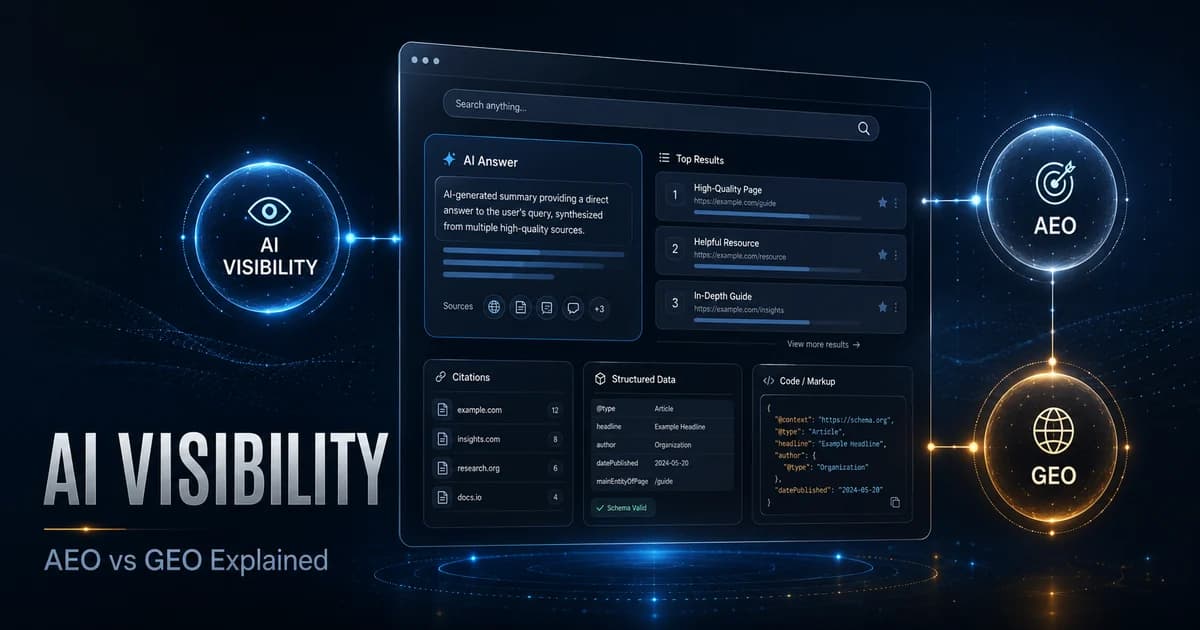
AI visibility is how often your law firm is found, understood, cited, and recommended when a potential client uses an AI tool to research a legal question. AEO (answer engine optimization) and GEO (generative engine optimization) are the two methods that produce that visibility. AEO is the work of structuring content so it can be pulled into answer style results. GEO is the work of becoming a source that AI systems reference inside generated answers. AI visibility is the outcome. AEO and GEO are how you get there.
Most law firms still think about search the way they did five years ago. Rank on Google, earn clicks, sign cases. That model is not gone, but it is no longer the whole picture. Clients now ask ChatGPT, Gemini, Perplexity, Microsoft Copilot, and Google AI Overviews to explain claims, compare firms, and recommend a lawyer before they ever click a website. If your firm is missing from those answers, you can lose a prospect before they know your name. This guide explains AI visibility, AEO, and GEO in plain language, shows how they connect to the SEO you already pay for, and lays out what to fix first. For the service version of this work, see our AI visibility for law firms page.
The Search Shift Law Firms Cannot Ignore
Search behavior has already moved. Google AI Overviews now appear on a large share of searches and reach more than two billion people each month, according to Google Search documentation. ChatGPT serves hundreds of millions of weekly users, and a growing portion of those sessions are searches rather than chats. Venture analysts at Andreessen Horowitz describe this as a structural change in how people find information, not a passing trend. The practical effect is simple. A real share of legal research now happens inside an AI answer, where there is often no list of ten blue links to scroll.
This matters more for legal than for most industries. The longer, question style searches that signal real intent, such as what to do after a car accident or whether someone has a valid claim, are exactly the queries AI tools love to answer directly. The American Bar Association has covered how AI powered search is reshaping the way clients find counsel. For the practitioner level walkthrough, our guide on AI search visibility for law firms shows how attorneys actually surface inside those answers.
This shift is visible across the legal marketing landscape. A growing set of distinct AI visibility queries now comes from law firm prospects, including ai visibility for law firms, chatgpt visibility for law firms, ai visibility audit for law firms, legal search visibility, and even rank my law firm in chatgpt search. The volume per term is still small, which is exactly the point. These are emerging queries, not saturated ones. The firms that build clear, citeable pages for them now are positioning to own the answer as that demand grows, instead of scrambling to catch up once every competitor has noticed.
What Is AI Visibility?
AI visibility is the likelihood that your firm is mentioned, cited, or recommended when someone asks an AI system a question related to your practice area and location. It is the outcome you want, not a single tactic. A firm with strong AI visibility shows up when a prospect asks Perplexity for the best injury lawyers in a city, or asks ChatGPT to explain how a claim works and which firms handle it.
AI visibility breaks into three layers. First, your pages must be findable, which means AI crawlers can reach and read them. Second, your content must be understandable, which means AI systems can identify your firm, your services, your locations, and your credibility. Third, your content must be citeable, which means it gives clear, self contained answers an AI can quote with confidence. AEO and GEO are the methods that strengthen those layers. Our AI visibility service page covers how VerdictIQ builds each one.
What Is AEO (Answer Engine Optimization)?
AEO, or answer engine optimization, is the practice of structuring content so it can be lifted directly into answer style results. Those are the features that give a person a single, direct response: Google AI Overviews, featured snippets, the People Also Ask box, and voice answers. AEO asks a focused question. When a prospect asks this exact thing, can a machine extract a clean answer from your page?
In practice, AEO means leading each section with a direct answer, keeping key passages to roughly forty to sixty words, writing headings that match how people phrase questions, and adding FAQ and how to content that mirrors real prospect language. It also leans heavily on schema markup, which tells search systems what a passage is. Our guide to structured data for AI search explains which schema types actually help a law firm get pulled into answers. For the full playbook, see AEO for law firms.
What Is GEO (Generative Engine Optimization)?
GEO, or generative engine optimization, is the practice of becoming a source that AI models reference inside the answers they generate. Where AEO targets answer features inside search, GEO targets the large language models behind tools like ChatGPT, Gemini, Perplexity, and Copilot. The goal is not to rank a page. The goal is to be one of the sources the model trusts enough to cite. See GEO for law firms for the full playbook.
Research backs up what actually moves GEO. The Princeton study that defined the term, published on arXiv, found that adding cited sources lifted AI citation rates by roughly forty percent, and adding relevant statistics lifted them by about thirty seven percent. Notably, keyword stuffing reduced visibility. The broader field is summarized well on Wikipedia. For law firms, GEO means clear claims, real data, named experts, and unmistakable entity signals. Our AI citeable content framework turns this into a repeatable structure.
AI Visibility vs AEO vs GEO: The Difference in One Table
The fastest way to keep these straight is to treat AI visibility as the result and AEO and GEO as the two methods that produce it. The table below shows how each one differs in surface, tactic, schema, and measurement.
| Dimension | AI Visibility | AEO | GEO |
|---|---|---|---|
| What it is | The outcome: being found, cited, and recommended by AI | A method: optimizing for answer style results | A method: becoming a cited source in generated answers |
| Primary surfaces | Every AI and search answer experience | Google AI Overviews, snippets, voice answers | ChatGPT, Gemini, Perplexity, Copilot |
| Core tactic | Clarity, authority, and structure across the whole site | Direct answers, FAQ, schema, concise definitions | Citeable claims, statistics, sources, entity clarity |
| Main schema | Organization, LocalBusiness, Article | FAQPage, HowTo, QAPage | Article, Organization, clear citations |
| How you measure it | Mentions and referrals across AI tools | Snippet and AI Overview presence | Citation share inside AI answers |
| Who it serves | Prospects at every research stage | People asking direct questions | People asking AI to compare or recommend |
How AEO, GEO, and AI Visibility Connect to SEO
None of this replaces traditional SEO. It sits on top of it. AI systems still need to crawl, render, and understand your pages, which means the technical foundation of SEO, fast pages, clean URLs, working internal links, accurate sitemaps, and open access for AI crawlers, is the price of entry. If a search engine cannot read your site well, an answer engine will not either. Strong SEO is the floor that AEO and GEO build on.
The important difference is that AI visibility does not depend on a top ranking the way classic SEO does. Studies have shown a surprisingly small overlap between the pages Google ranks and the sources AI tools cite. A well structured page on the second or third results page can still be quoted inside an AI answer if it gives a clearer, more citeable response than the pages above it. That is why content structure and source quality matter independently of position, a point we explore in our guide to law firm ChatGPT visibility.
Why This Matters More for Law Firms
Three things make AI visibility especially valuable for legal practices. The value of a single signed case is high, so even a handful of AI driven consultations can move the needle. Trust signals carry extra weight, because clients researching a lawyer want experience, credentials, and proof, which are the same signals AI systems weigh when deciding whom to cite. And legal intent is often local, which plays into the city specific answers AI tools increasingly produce.
There is also a structural risk. When an AI tool recommends lawyers, it usually returns a short list, not a full page of options. If your firm is not on that list, you are effectively invisible for that query, even if you rank well in classic search. Measuring this is its own discipline, which we cover in the LLM mention audit for law firms, and turning visibility into signed cases is the focus of our case visibility guide.
How to Make Your Law Firm Site Easier for Google and AI to Understand
Most firms do not need a brand new content calendar to start. They need to make the pages that already matter clearer, more structured, and easier to cite. The four moves below cover the bulk of the work.
Answer the real questions first
Find the questions prospects actually ask before they hire, then answer each one directly near the top of the relevant page. Lead with the answer, then explain. Avoid burying the useful sentence under three paragraphs of marketing copy. The cleaner and more self contained your answers are, the easier they are for both readers and AI systems to use.
- Open each section with a direct answer of roughly forty to sixty words
- Use headings that match how prospects phrase questions to an AI tool
- Add an FAQ section in natural client language, not legal jargon
- Use comparison tables for any versus or which is better question
- Show named authors, real credentials, and a visible last updated date
Add structured data and machine readable files
Schema markup gives AI systems labeled context about your content, such as FAQPage for questions, LocalBusiness for your offices, and Article for guides. Pages with proper schema are cited noticeably more often. It is also worth adding an llms.txt file, a simple standard described at llmstxt.org, that gives AI systems a quick map of your firm and its key pages. Our structured data guide walks through the schema that helps law firms, and the official definitions live at schema.org.
Build entity clarity and authority
AI systems decide whom to trust partly by how clearly your firm is defined across the web. Keep your name, address, and phone consistent everywhere. Give every attorney a real bio with credentials and case focus. Earn mentions on legal directories, bar association resources, and reputable publications, because AI tools often cite a firm through third party sources more readily than through its own site. Consistent, verifiable signals make your firm an easier source to recommend.
Connect visibility to intake
Visibility only matters when it produces consultations. If an AI tool sends a prospect to your site at ten at night and the call goes unanswered, the work is wasted. Make sure the path from discovery to consultation is fast, with clear calls to action, easy forms, and after hours coverage. AI intake, such as GateKeeperAI, answers, qualifies, and books leads when AI search or SEO creates demand, so new visibility turns into signed cases instead of missed opportunities.
Consider a realistic example. A prospect opens Perplexity late at night and asks what to do after a rear end collision in their city. The tool returns a short summary and names two or three firms it considers credible, each with a citation. If your firm published a clear, well structured page on that exact question, marked it up with schema, and earned a few reputable mentions, you can be one of the named firms. If your only relevant page is a thin, undated paragraph buried in a services menu, you are absent from that answer even if you outrank those firms in classic Google results. Closing that gap is the entire point of AI visibility work.
Common AI Visibility Mistakes Law Firms Make
Most firms do not lose AI visibility because they did something dramatic. They lose it through small, fixable habits that make their content harder for AI systems to read, trust, or quote. The patterns below show up again and again in law firm audits.
- Blocking AI crawlers like GPTBot or ClaudeBot in robots.txt, which quietly removes the firm from those tools entirely
- Hiding key answers inside long marketing copy instead of stating them directly near the top
- Publishing thin practice area pages that never explain the firm, the market, or the case type clearly
- Skipping schema markup, so AI systems have to guess what each passage means
- Leaving content undated, which makes AI tools favor fresher competitors
- Treating each blog post as an island with no internal links into a topic cluster
- Generating traffic with no way to tell whether AI or search produced a consultation
The most expensive mistake is the quietest one. If a firm blocks AI crawlers or buries everything behind scripts and gates, the strongest content in the world cannot be cited, because the systems that would cite it never see the words. The fix is rarely glamorous. Open access to reputable AI bots, make the most useful pages readable without barriers, and confirm the important pages appear in the sitemap and respond cleanly to crawlers.
The second most expensive mistake is measuring nothing. A firm that cannot tell which channel produced a signed case cannot decide where to invest. Tie AI and referral traffic to calls, forms, and consultations, then review it on a schedule. The AI visibility audit for law firms gives a structured way to catch these issues before they cost cases.
Which Should a Law Firm Focus On First?
Sequence beats effort here. Start with the foundation, which is solid SEO plus clear, well structured pages, because both AEO and GEO depend on it. Layer AEO next, since answer style optimization can shift results within weeks once schema and direct answers are in place. Treat GEO as the longer game, because being cited by AI models depends on authority and third party signals that build over months. The honest first step for most firms is a diagnostic, not a content sprint. Run our free AI visibility checker, then use the AI visibility audit for law firms to decide what to fix before publishing more.
How VerdictIQ Builds AI Visibility for Law Firms
AI visibility fails when it is treated as a content stunt. It works when SEO, AEO, GEO, tracking, and intake are built as one system. VerdictIQ audits how your firm appears to search engines and AI crawlers, structures your highest value pages to be understood and cited, and connects that visibility to the calls, forms, and consultations that prove it worked. You can see the strategy on our AI visibility page and the search to case system on our personal injury lawyer SEO page.
Frequently Asked Questions
Is AEO the same as GEO?
They overlap but are not identical. AEO, or answer engine optimization, focuses on answer features inside search, such as Google AI Overviews and featured snippets. GEO, or generative engine optimization, focuses on being cited by large language models like ChatGPT, Gemini, and Perplexity. Many teams use the terms together because the underlying work, clear and citeable content, is shared.
Is AI visibility just SEO with a new name?
No. SEO gets your pages ranked. AI visibility gets your content found, cited, and recommended inside AI answers. Strong SEO is the foundation that AI systems often draw from, but content structure, schema, and entity clarity affect AI citation independently of ranking position. A page can be cited by AI even when it is not ranked first.
Which matters more for law firms, AEO or GEO?
Both matter, but for different prospects. AEO captures people asking direct questions inside Google. GEO captures people asking ChatGPT or Perplexity to explain a claim or recommend a firm. Most law firms should build the shared foundation first, add AEO for fast wins, and invest in GEO authority over time.
Do AEO and GEO replace traditional SEO?
No. They sit on top of SEO. AI systems still need to crawl, render, and understand your site, which depends on technical SEO fundamentals. If a search engine cannot read your pages well, an answer engine will not cite them. The strongest strategy layers SEO, AEO, and GEO together rather than choosing one.
How do law firms measure AI visibility?
Test your top questions across ChatGPT, Perplexity, and Google AI Overviews and record whether your firm is mentioned and which page is cited. Track referral traffic from AI sources in analytics, and watch impressions in Search Console for AI related queries. A structured LLM mention audit makes this repeatable month over month.
How fast can a law firm improve AI visibility?
Structural fixes like schema, llms.txt, and clearer answer blocks can influence AI citation within weeks because AI crawlers index frequently. Gains that depend on domain authority and third party citations usually take three to six months. Local AI visibility for city specific queries often responds faster than broad category queries.
Ready to find out where your firm stands? Run the free AI visibility checker for a fast read on your schema, llms.txt, and AI crawlability, then book an AI visibility audit to get a prioritized plan across SEO, AEO, GEO, and intake.