

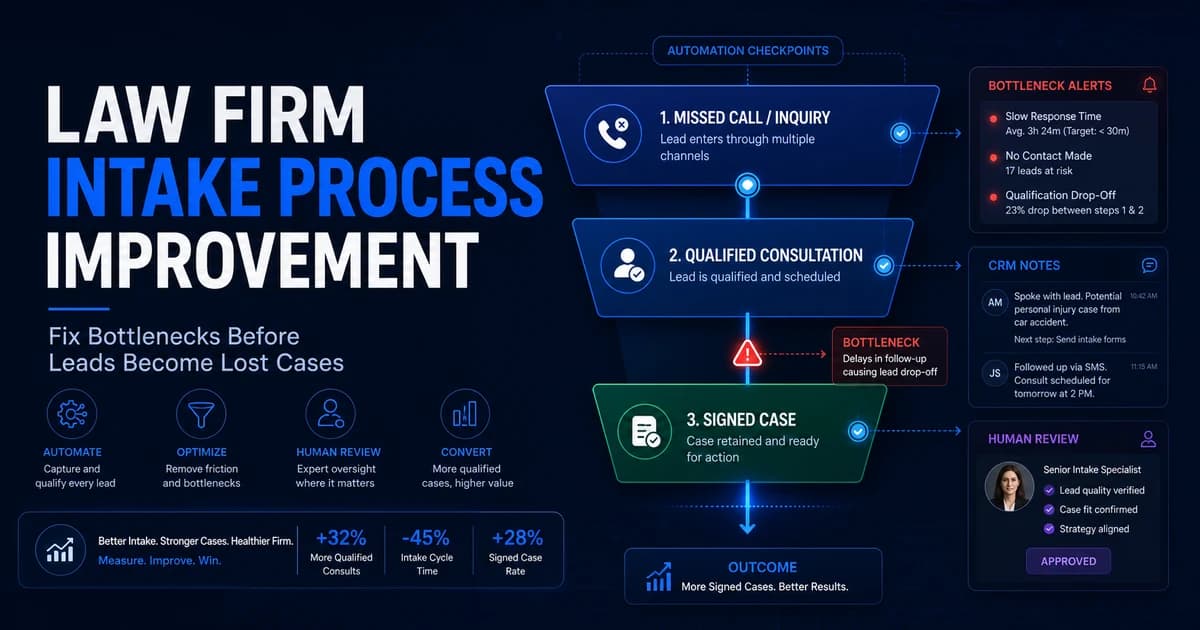
Law firm intake process improvement is the work of finding where qualified leads slow down, fall through, get mishandled, or fail to become signed cases. It is not only a software question. A firm can buy a new intake platform and still lose prospects if calls are missed, forms sit unanswered, qualification is inconsistent, follow-up is weak, or nobody measures the path from inquiry to consultation.
Law firm intake is a heavily searched cluster: law firm intake, client intake law firm, law firm client intake procedures, legal intake best practices, and law firm intake process improvement. Rather than repeat the broad law firm intake process guide, this post focuses on improvement: how to diagnose bottlenecks and decide what to fix first.
For law firms, intake is where marketing becomes business development. SEO, paid ads, referrals, AI visibility, and website traffic all become fragile at the intake step. If the firm cannot respond quickly, qualify cleanly, route accurately, and follow up consistently, better visibility may only create more missed opportunities.
Why Intake Improvement Comes Before More Lead Spend
Many firms try to solve growth problems by buying more traffic. They increase ad spend, publish more content, or chase more visibility. That can help, but it can also expose a broken intake process. If the firm misses calls, responds slowly, fails to document facts, or has no consistent follow-up, more leads only make the leak more expensive.
Intake improvement should come before aggressive growth spending because it protects every channel. A better intake process makes SEO more valuable. It makes ads more accountable. It makes AI visibility more useful. It makes referrals less likely to be wasted. The firm does not need a perfect system before marketing, but it does need a system that can handle increased demand.
The missed-call cost guide explains why after-hours and unanswered inquiries matter. This guide goes one level deeper into the full process from first contact to signed case.
Map the Intake Path Before You Change Tools
The first step is mapping what actually happens today. Do not start with what the intake process is supposed to be. Start with the real path. Where does a lead enter? Who sees it first? How quickly does the firm respond? What questions are asked? Where are notes stored? Who decides whether the lead is qualified? How is the consultation booked? What happens if the prospect does not answer?
This map should include phone calls, website forms, chat, referral emails, paid ad leads, local listing messages, after-hours inquiries, and any AI-assisted intake channel. Every lead source should have a clear owner, response expectation, documentation standard, and next step.
Once the path is visible, bottlenecks become easier to find. The firm may discover that calls are answered quickly but follow-up is weak. It may discover that forms are handled slower than phone calls. It may discover that intake staff collect information but attorneys do not receive clean summaries. The map turns vague frustration into specific fixes.
The Intake Metrics Law Firms Should Track
A law firm intake process cannot be improved if nobody measures it. The firm does not need a complicated dashboard at first, but it does need consistent metrics that show where leads are created, delayed, qualified, booked, and signed.
| Metric | What It Shows | Why It Matters |
|---|---|---|
| Response time | How quickly the firm replies after a lead arrives | Slow response reduces the chance of booking a consultation |
| Answer rate | How often calls are answered live | Missed calls can become lost cases |
| Lead source | Where inquiries come from | The firm can compare SEO, ads, referrals, and local listings |
| Qualification rate | How many leads fit the firm's criteria | More calls are not useful if they are poor fit |
| Consultation booking rate | How many qualified leads schedule | This shows whether intake turns interest into next steps |
| Show rate | How many booked prospects attend | Follow-up quality often appears here |
| Signed-case rate | How many consultations become clients | This connects intake to real business outcomes |
These metrics also help evaluate marketing. A page may produce traffic, but if the consultation booking rate is low, the issue may be page intent, case fit, form quality, response time, or intake script. Without intake metrics, marketing problems and operations problems get mixed together.
Fix Response Speed First
Response speed is usually the first intake bottleneck to inspect because it is easy to understand and costly to ignore. A prospect with a legal problem may contact more than one firm. If the firm waits hours to respond, the lead may already be booked somewhere else.
Improving response speed does not always require a complex tool. It may require clearer ownership, better call routing, after-hours coverage, backup notifications, form alerts, or an AI-assisted front desk that captures essential information when staff are unavailable.
For firms that need AI-supported intake, GateKeeperAI is designed around that handoff: respond, capture, qualify, and route so the firm has a cleaner record of what happened after the inquiry arrived.
Standardize Qualification Without Making Intake Robotic
Qualification is where many intake processes become inconsistent. One staff member may ask detailed questions. Another may collect only a name and phone number. One may recognize urgency. Another may miss a key fact. One may route the prospect correctly. Another may send the lead into a general inbox.
A better process gives intake staff a consistent structure while still leaving room for human judgment. The firm should define required questions by practice area, red flags that require escalation, disqualifying factors, urgency signals, referral paths, and the notes attorneys need before a consultation.
The goal is not to turn intake into a script that ignores the person. The goal is to make sure the firm collects the information needed to respond responsibly and efficiently. The law firm intake best practices article covers the broader standards; this section is about making those standards operational.
Create a Clear Handoff to Attorneys
A lead can be captured correctly and still lose momentum if the handoff is unclear. Attorneys need enough context to evaluate the prospect without digging through scattered notes. Intake staff need to know what qualifies as urgent, what should be escalated, and what can be scheduled through a normal workflow.
The handoff should include source, contact details, basic facts, practice area, urgency, conflict indicators if relevant, documents or photos mentioned, prior attorney involvement, appointment status, and the recommended next step. If AI summarizes the intake call or chat, a human should review important summaries before they are treated as reliable.
This is where the AI audit trails for law firms concept becomes practical. When AI touches intake notes, the firm should know what was generated, what was reviewed, and what action followed.
Improve Follow-Up Before Adding More Automation
Follow-up is one of the easiest places to lose qualified leads. A prospect may complete a form but miss the first call. A qualified lead may book a consultation but forget the appointment. A caller may need to send documents before an attorney can evaluate the matter. If the process depends on memory, leads will fall through.
Automation can help, but only after the firm defines the follow-up rules. When should a text go out? When should a staff member call again? When does the lead move to inactive? When should an attorney review an exception? How many touches are appropriate? What language should be used so follow-up is helpful rather than pushy?
The law firm intake automation guide explains where automation helps and where it breaks. Improvement starts with the rules. Automation simply makes those rules easier to execute consistently.
Use Technology to Support the Process, Not Replace It
Technology should make the intake process clearer, faster, and easier to measure. It should not hide responsibility. A new platform can capture more data, but the firm still needs to decide what data matters. AI can summarize calls, but humans still need to review important facts. Automated reminders can reduce no-shows, but someone still needs to own the consultation outcome.
The right tool depends on the firm's volume, practice area, staffing, case criteria, and reporting needs. The law firm intake software guide explains what attorneys should look for before buying. This improvement guide should help the firm know what problems the tool needs to solve.
How Intake Improvement Supports SEO and AI Visibility
Intake improvement supports SEO because organic traffic only matters when it turns into qualified conversations. A firm can rank for better keywords and still underperform if calls are missed, CTAs are weak, forms are confusing, or follow-up is inconsistent.
It also supports AI visibility. If the firm becomes easier to find through AI-assisted discovery, prospects may arrive with more specific questions. The intake process needs to capture those questions, route them to the right person, and help the firm learn which AI visibility efforts are producing useful demand.
Google Search Console's performance reports can show which queries and pages are creating search exposure. Intake data shows whether that exposure is turning into real opportunities. The firm needs both.
A 30-Day Intake Improvement Plan
A practical improvement plan should be short enough to execute. Start with one month. Do not rebuild every system at once. Pick the biggest leak, fix it, and measure whether the change improves the path from inquiry to consultation.
- Week 1: map every lead source, owner, response path, and handoff
- Week 1: review recent missed calls, unanswered forms, and unbooked qualified leads
- Week 2: define required qualification fields by practice area
- Week 2: create response-time targets for calls, forms, chat, and after-hours inquiries
- Week 3: standardize consultation booking, reminders, and no-show follow-up
- Week 3: connect lead source, qualification status, consultation status, and signed-case outcome
- Week 4: review bottlenecks and decide which workflow should be automated first
This plan gives the firm a practical baseline. After that, automation, AI intake, reporting dashboards, and software changes become easier to evaluate because the firm knows what it is trying to improve.
Common Intake Improvement Mistakes
The first mistake is treating every inquiry as equal. Some leads are urgent, some are poor fit, some need attorney review, and some need a referral. The process should reflect those differences instead of forcing every prospect through the same path.
The second mistake is tracking only lead volume. A firm can get more inquiries and still sign fewer good cases if quality drops or follow-up breaks. Track qualified leads, booked consultations, show rate, signed cases, and source quality.
The third mistake is automating before defining the rules. Automation makes a clear process faster. It makes a messy process harder to inspect. Before adding automation, define the workflow, the owner, the exceptions, and the review points.
Review Intake by Source, Not Only in Total
Total lead volume can hide the real issue. A firm may have strong referral leads, weak paid leads, slow form response, and high-intent organic calls all mixed into one number. Intake improvement becomes much clearer when the firm reviews each source separately.
Start by comparing organic search, paid search, referrals, local listing calls, website forms, chat, after-hours calls, and AI-assisted channels. For each source, review response time, qualification rate, consultation booking rate, show rate, and signed-case rate. The goal is to find which channel is producing quality and which channel is producing friction.
This can change the next marketing decision. If organic search produces fewer leads but better case fit, the firm may need stronger SEO and better content. If ads produce many low-fit leads, the firm may need tighter targeting or landing-page changes. If referrals convert well but response is slow, the problem may be operational rather than marketing.
Create an Intake Review Meeting
Intake improvement should have a standing review cadence. A short weekly or biweekly meeting can be enough. The meeting should include the person responsible for intake, someone who understands marketing source data, and a decision-maker who can approve process changes.
The meeting should not become a vague discussion of lead quality. It should review the actual path: missed calls, slow responses, unbooked qualified leads, no-shows, unsigned consultations, source quality, and exceptions that required attorney review. Every meeting should end with one or two changes, not a long list nobody owns.
- Review the last seven to fourteen days of new inquiries
- Identify the biggest lead source by qualified opportunities
- Inspect missed calls and slow-response records
- Review leads marked unqualified and confirm the reason
- Check booked consultations that did not show
- Check consultations that did not sign and note the reason when known
- Assign one process fix and one measurement fix before the next meeting
What to Fix First
The first fix should usually be the bottleneck closest to revenue. If qualified leads are not being booked, fix booking and follow-up before rewriting every website page. If consultations are booked but prospects do not show, fix reminders and confirmation. If calls are missed, fix routing and coverage. If the firm cannot tell which source created the lead, fix tracking.
This order matters because it protects the value of existing demand. A firm does not need to wait months for more traffic to improve results. Sometimes the fastest growth comes from converting the opportunities already arriving. That is why VerdictIQ treats intake, tracking, and visibility as one system rather than separate projects.
After the closest revenue leak is fixed, move upstream. Improve landing-page clarity, practice-area content, local visibility, AI search visibility, and service-page structure. Better marketing will matter more once the intake process can capture and convert the demand it creates.
How to Know the Process Is Improving
A better intake process should show up in the numbers. Response time should fall. Answer rate should rise. Qualified lead notes should become more consistent. Consultation booking rate should improve. No-shows should become easier to explain. Signed-case rate should become easier to compare by source.
The firm should also feel the difference. Attorneys should receive cleaner summaries. Intake staff should know what to do next. Prospects should receive faster responses. Follow-up should happen without relying on memory. Marketing decisions should become easier because the firm can see which demand sources create real opportunities.
Improvement does not mean every lead becomes a client. It means the firm can explain what happened. Good leads should move faster. Bad-fit leads should be identified earlier. Exceptions should be escalated. Missed opportunities should become visible enough to fix.
How Intake Notes Improve Future Marketing
Intake notes are also a source of marketing intelligence. They show the words prospects use, the questions they ask before booking, the objections that slow them down, and the facts they struggle to explain. When those patterns are reviewed carefully, they can improve service pages, FAQ-style answers, AI visibility content, and paid search landing pages.
For example, if callers repeatedly ask whether they have a case after a minor accident, the firm may need clearer content about case evaluation. If prospects do not understand what documents to bring, the consultation page may need a better preparation section. If leads from one practice area are often poor fit, the firm may need sharper qualification copy before the form is submitted.
This turns intake from a back-office task into a feedback loop. Marketing creates demand, intake records what prospects actually need, and the website improves based on real questions rather than guesses. That loop is one of the simplest ways to make SEO, AI visibility, and intake work together.
Final Takeaway
Law firm intake process improvement is about turning demand into better outcomes. The firm should know where leads enter, how quickly they receive a response, how qualification works, how handoffs happen, how follow-up is handled, and how many qualified prospects become signed clients.
If your firm wants to fix intake before spending more on traffic, book a VerdictIQ strategy call. We will help map the bottlenecks, define the measurement path, and decide where AI or automation can help without losing human judgment.
Frequently Asked Questions
What is law firm intake process improvement?
It is the process of finding and fixing bottlenecks between first inquiry and signed case, including response speed, qualification, handoff, follow-up, and reporting.
Should a law firm buy intake software first?
Not always. The firm should first map the intake workflow and identify the bottleneck. Software is more useful when the firm knows what process problem it needs to solve.
How does intake improvement help SEO?
SEO creates visibility, but intake determines whether that visibility turns into calls, consultations, and signed cases. Better intake makes every marketing channel more valuable.